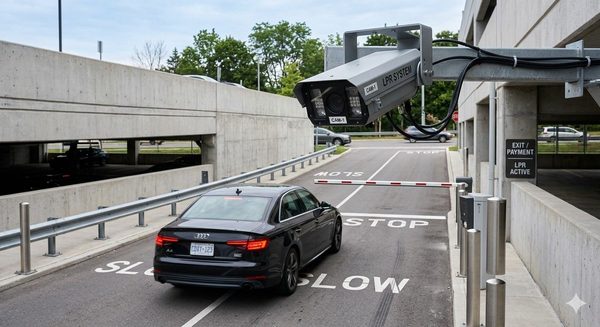
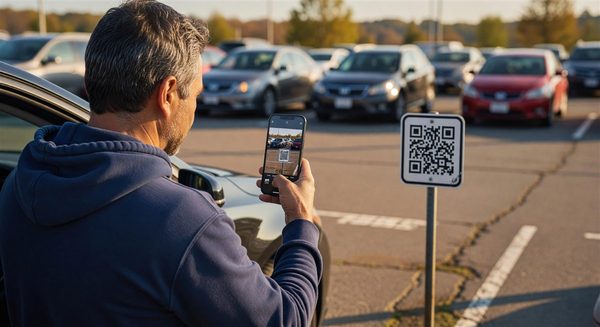
Pay-by-plate looks simple from the driver’s side: enter your plate, pay, and walk away. Behind it sits a matching problem. A payment tied to a plate string has to be compared with a camera read or a handheld enforcement entry, and the two must agree character for character. When they do not, either a paying customer is treated as a violator or a violator escapes. How an operator designs the flow, and what it does with near-misses, determines how many disputes land on the customer service desk.
The Basic Flow
Most pay-by-plate flows move through the same stages:
- Capture. The plate enters the system through a driver’s typed entry (kiosk, app or web), through an automatic plate recognition camera at entry, exit or on an enforcement vehicle, or both.
- Normalization. The system strips spaces and punctuation, standardizes case, and often records the state or region as part of the key.
- Association. The plate is tied to a payment record, a session with a start and end time, or a stored account with a payment method.
- Verification. At enforcement time, or at exit, the system compares the plate it sees against active sessions.
- Resolution. A match releases the vehicle or clears the check. A non-match triggers a charge, a review queue or a citation.
Each stage can introduce an error, and most designs stop only at stage five.
Why Mismatches Happen
Driver entry errors
Typing errors are a recognized source of trouble. EasyPark’s help guidance says a typo or an outdated plate number stored in a user’s account can lead to sessions being assigned to the wrong vehicle. Confusable characters such as O and 0, or I and 1, are the usual culprits, as are plates for a different vehicle than the one parked, a rental car, or a recent plate change. No source reviewed quantified how common entry errors are compared with camera errors, so do not assume a ratio; measure it in your own data.
Camera misreads
Automatic plate recognition is accurate in aggregate and wrong often enough to matter at volume. Which? reports that the industry cites a figure of about 97 percent accuracy, and that the remaining 3 percent still produces misreadings daily. That is a UK consumer-group statement about the industry’s own claim, not an independent test of any one product. Genetec, a vendor, notes that misreads and false positives require human intervention, particularly at scale. Poor lighting, dirt on the plate, angle, and similar-looking characters are standard causes. Treat vendor accuracy figures as scan-level claims and test performance at your own sites, in your own weather.
Enforcement strictness
Enforcement rules shape how costly a mismatch is. A published piece from the City of Spokane explains that enforcement staff compare the exact plate number entered in the app, and that they cannot excuse a wrong plate on the basis of make, model or color. If your policy is exact-match-only, every entry error becomes a citation unless you build in a correction path.
Designing for Near-Misses
Fuzzy matching with a human in the loop. Flag payments that differ from a read by one character, a transposition or a confusable pair, and route them to a review queue rather than directly to a citation. Do not auto-forgive them either; a review step keeps abuse in check.
Confirmation at entry. Ask drivers to confirm the plate on a summary screen and show the plate and vehicle type clearly. When a camera has read the plate at the lane, prefill it and let the driver correct it. Fewer typed characters means fewer errors.
Grace windows. Allow a short, published period after session start in which a driver can correct a plate without a fee. State the length in your signage and terms. This is a policy choice, not an industry standard.
Notification. When a session is created, send a confirmation by text or email that shows the plate. A driver who sees the wrong characters can fix them before leaving the lot.
Evidence retention. Store the camera image, the read confidence, the entered plate, the payment time and the session record. Disputes are decided on evidence, and the plate image is the most persuasive item you can offer either side.
Handling Disputes
Whatever you decide, publish the rules and keep them consistent. Three elements matter most.
First, an easy correction route: a web form or app flow where drivers upload a receipt and photo of the plate. Second, a defined appeal window, with the number of days stated on every notice; for example, one university campus in Spokane publishes a 10-calendar-day appeal period, though that is one institution’s rule, not a standard. Third, a clear position on payment-versus-plate outcomes. Payment platforms such as Parkmobile say they can ask the operator to consider dismissing a citation when a driver paid for the wrong plate, but they neither issue citations nor guarantee results. Outcomes also differ by jurisdiction; a Scottish tribunal case reported in the legal press saw a council win on appeal after a driver entered a registration with errors, which shows that proof of payment alone does not settle every dispute. Take advice on the rules that apply to your sites.
Metrics Worth Tracking
Track the share of sessions with a plate edited after payment, the rate of near-match flags per thousand sessions, the proportion of citations canceled on appeal, and the average time to resolve a dispute. If cancellations are high, the flow, signage or matching logic needs repair, not the appeals process. Those four numbers will tell you more about the health of a pay-by-plate operation than any vendor accuracy claim.