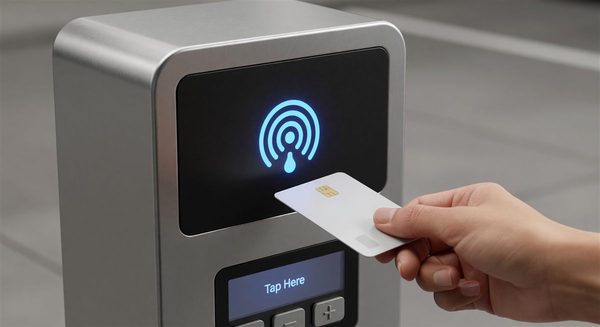
NFC contactless readers work beautifully in retail — tap, beep, done. Drop the same reader into a parking pay station in a metal enclosure, outdoors, next to a printer motor, with a polycarbonate weather shield over the faceplate, and failure rates climb. Every one of those environmental factors detunes the antenna, attenuates the field, or injects noise. NFC at a parking pay station is an engineering problem, not a drop-in feature, and operators who do not understand it end up blaming the card network for problems that live in their own hardware.
What Has to Work
An NFC contactless transaction follows the EMVCo Contactless Specifications and operates at 13.56 MHz. The reader generates an RF field, the card or phone antenna couples to it, and modulated data flows in both directions. For the transaction to complete:
- Field strength at the card position must exceed the minimum defined by the kernel.
- Field uniformity across the read zone must be within spec so that an off-center tap still works.
- Load modulation from the card must be detectable over whatever noise is in the environment.
- Timing of the protocol exchange must meet sub-millisecond tolerances.
Any one of those going wrong produces a “tap again” message that the patron reads as a broken terminal.
Sources of Detuning
Metal enclosure
A metal cabinet around the antenna acts as an RF shield and as a capacitive load that shifts the antenna’s resonant frequency. Off-resonance operation drops field strength dramatically. Solutions include ferrite shielding between the antenna and the metal, non-metallic faceplates in the read zone, or antennas tuned specifically for metal-backed mounting.
Neighboring electronics
Switching power supplies, motor drivers for bill validators and coin hoppers, and receipt printer heaters all radiate noise at frequencies that can interfere with the 13.56 MHz fundamental or its harmonics. Cable routing, shielded harnesses, and careful grounding reduce the impact. Some operators find that certain pay station configurations have to disable NFC reads while the printer is actively printing — a workaround rather than a fix.
Weather shield
A polycarbonate or glass weather shield in front of the reader adds distance between the card and the antenna and can introduce dielectric losses. Thicker shields reduce field strength; tinted shields can carry metallic particles that attenuate the RF. Shield material and thickness should be validated against the reader’s approved install guide.
Temperature
Antenna tuning components — capacitors and inductors — drift with temperature. A reader tuned at 25 degrees Celsius in a factory lab may be out of spec at -20 degrees in a winter parking lot. Outdoor-rated readers use temperature-stable components or active tuning; consumer-grade modules often do not.
Condensation and ice
Water on the faceplate is mostly transparent to 13.56 MHz but can conduct if salts are dissolved. Ice over the reader has little RF effect but physically prevents close coupling — the card cannot get close enough to the antenna to generate adequate modulation.
Certification
Every NFC reader intended for card-brand acceptance must pass EMVCo Level 1 (analog) and Level 2 (digital protocol) testing. The Level 1 tests specifically evaluate field strength, uniformity, and protocol timing under defined conditions. A reader that passes certification in a lab configuration can still fail in a deployed configuration if the installation changes the RF environment. Some EMVCo Letters of Approval specify mandatory installation constraints — minimum metal-free zones around the antenna, maximum faceplate thickness, cable specifications — that are part of the certified configuration.
Installing a certified reader outside its approved configuration voids the certification and exposes the operator to scheme non-compliance fines in the event of a problem.
Practical Tuning Approach
The serious approach to NFC at pay stations:
- Use a reader certified for outdoor use with the specific installation geometry.
- Follow the vendor’s installation guide exactly on faceplate material, thickness, and metal-free zones.
- Test field strength with a reference test card (EMVCo publishes test specifications for both Level 1 and Level 2).
- Test across the full operating temperature range on at least one unit before field deployment.
- Log tap-retry rate as a per-terminal metric and investigate outliers.
- Revisit tuning when replacing the faceplate, adding accessories, or upgrading adjacent hardware.
The Mobile Wallet Dimension
Mobile wallets (Apple Pay, Google Pay, Samsung Pay) use the same NFC physical layer as contactless cards but with slight differences in antenna position, field coupling, and protocol flow. Phones with cases — especially thick protective cases with metal plates for magnetic mounts — are particularly sensitive to detuning on the pay station side. A reader that is marginal on a physical card will fail frequently on phones with cases, producing a much higher tap-retry rate than card-only testing would predict.
Reliability Metrics
Healthy NFC deployments at parking pay stations usually run:
- Single-tap approval rate (first-tap success, no retry) above 97%.
- Total read-failure rate (tap, tap, give up) below 1%.
- Read-time median under 500 milliseconds, 95th percentile under 1 second.
Rates noticeably worse than these typically point to an antenna or environmental issue rather than a cardholder behavior issue. The IPMI operational reference materials recommend these as achievable targets for well-maintained unattended terminals.
FAQ
Can I just use the same NFC module that works in retail?
Only if it is certified for the specific outdoor, metal-mount, faceplate configuration of the pay station. Retail-configured modules typically fail outdoor certification requirements.
Does the card have to touch the faceplate?
No. NFC is intended to work with several centimeters of separation. A requirement to physically touch the reader is a symptom of weak field strength, not a design feature.
Does a thicker weather shield help or hurt?
Hurts, mostly. Thicker shields push the card further from the antenna and introduce dielectric losses. Use the thinnest shield that meets the enclosure’s mechanical requirements.
Can NFC performance be upgraded without hardware replacement?
Sometimes — firmware updates can adjust kernel parameters and field-strength drive levels within the certified range. Larger changes require hardware modifications that may re-trigger certification.