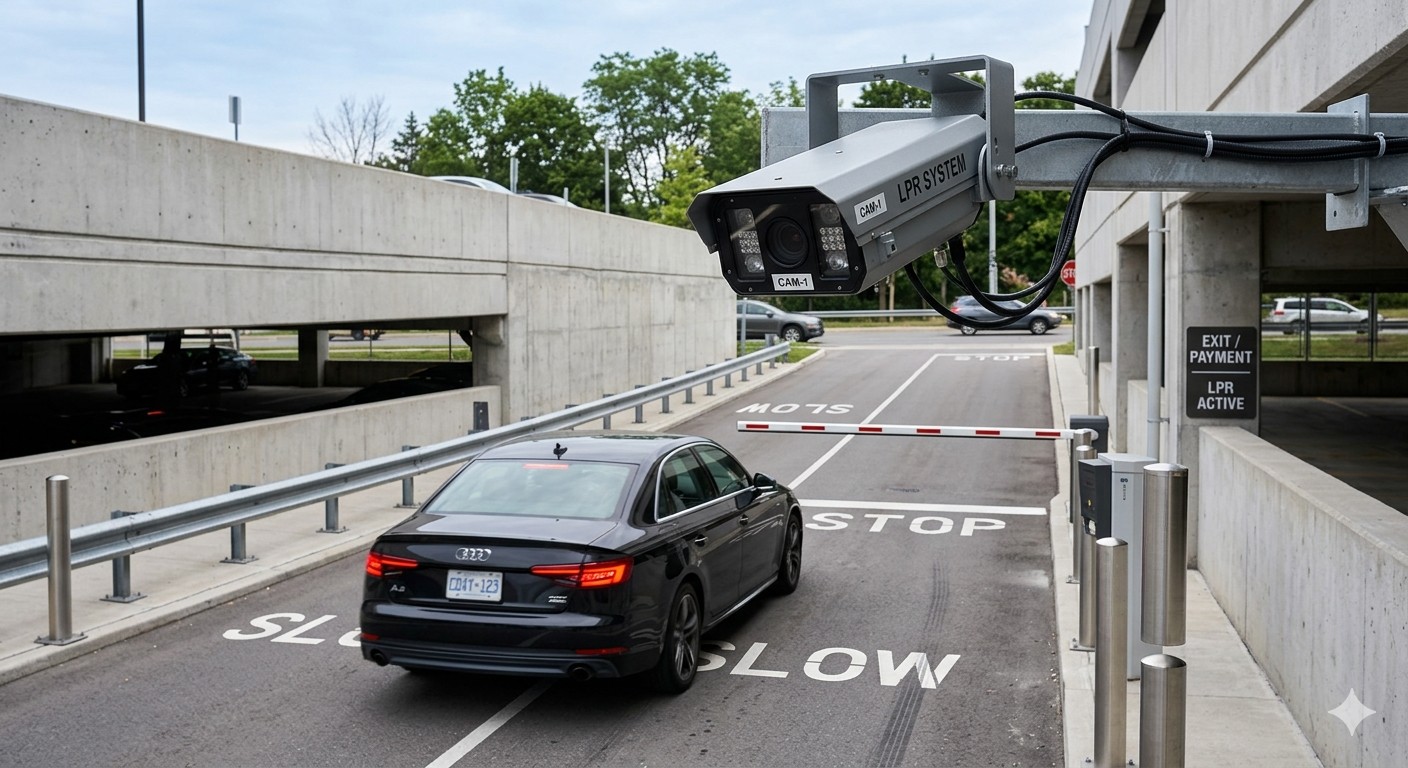
License plate recognition has quietly become the most significant technology shift in parking payments since the introduction of credit card acceptance at pay stations. LPR — also called ALPR (automatic license plate recognition) or ANPR (automatic number plate recognition) in some markets — uses cameras and optical character recognition software to read vehicle license plates in real time. When integrated into a parking payment system, the license plate becomes the transaction token, replacing physical tickets, access cards, and even tap-to-pay interactions.
The result is a frictionless experience for the driver: enter without stopping to take a ticket, park, pay via app or pay station, and exit without presenting anything. The gate opens automatically because the system knows the plate, knows the payment, and links the two.
This guide covers how LPR-based parking payments work, what hardware and software is required, and the practical realities operators encounter during deployment.
How LPR-Based Parking Payments Work
The Basic Transaction Flow
- Entry capture. An LPR camera at the entry lane reads the vehicle’s license plate as it approaches. The system records the plate number, a timestamp, and typically a full image of the vehicle.
- Barrier opens (if gated). In gated facilities, the barrier lifts automatically after a successful plate read. No ticket dispensed. In ungated facilities, the camera simply logs the entry.
- Parking session begins. The system starts a parking session tied to the plate number. The driver parks normally.
- Payment. The driver pays at a pay-on-foot station (entering their plate number or having it auto-detected), via a mobile app, or through a pre-registered account that charges automatically.
- Exit validation. An LPR camera at the exit lane reads the plate again. The system matches it to a paid session and opens the exit barrier. If unpaid, the system prompts the driver to pay or directs them to a pay station.
- Enforcement (ungated). In ungated environments, enforcement officers or mobile LPR vehicles scan plates and cross-reference active paid sessions. Unpaid vehicles receive citations.
What Happens Behind the Camera
The LPR process involves multiple software stages:
| Stage | Function |
|---|---|
| Image capture | Camera captures one or more frames of the vehicle’s front or rear plate |
| Pre-processing | Software adjusts for lighting, angle, motion blur, and contrast |
| Segmentation | Algorithm isolates the plate region from the rest of the image |
| Character recognition | OCR engine identifies individual characters on the plate |
| Confidence scoring | System assigns a confidence percentage to each character and the plate as a whole |
| Database lookup | Recognized plate is matched against active sessions, permit holders, or watchlists |
| Action trigger | Based on the match result, the system opens a gate, flags for enforcement, or logs the event |
Modern LPR systems achieve 95% to 99% accuracy under good conditions. The gap between 95% and 99% matters enormously at scale — a 95%-accurate system in a facility processing 2,000 vehicles per day will misread 100 plates daily, each requiring manual intervention or creating a revenue leak.
Hardware Components
LPR Cameras
LPR cameras are not standard surveillance cameras. They are purpose-built with specialized optics, sensors, and illumination for reading license plates on moving vehicles.
Key specifications to evaluate:
| Specification | Recommended Range |
|---|---|
| Resolution | 2-5 megapixels (higher is not always better — processing speed matters) |
| Frame rate | 30-60 fps for vehicles at entry/exit speeds |
| Infrared illumination | 850 nm for covert or 940 nm for invisible IR — essential for nighttime reads |
| Shutter speed | 1/1000s or faster to prevent motion blur at vehicle speeds up to 30 mph |
| Lens type | Varifocal, sized for the lane width and mounting distance |
| Weather rating | IP67 minimum for outdoor installations |
| Processing | Edge processing (on-camera OCR) or server-based — each has tradeoffs |
Major LPR camera manufacturers in the parking space include Genetec (AutoVu), HikVision, Axis Communications, Vigilant Solutions (now part of Motorola), and NDI Recognition Systems. Parking system manufacturers like Scheidt & Bachmann, Skidata, and Flowbird integrate LPR cameras into their PARCS platforms, either using their own camera hardware or certified third-party cameras.
Mounting and Positioning
Camera placement is the single biggest determinant of read accuracy. Poor mounting turns a great camera into an expensive paperweight.
Best practices:
- Mount height: 2.5 to 4.5 meters (8 to 15 feet) above the road surface
- Angle: 15 to 30 degrees from horizontal, aimed at the plate zone
- Distance: 3 to 8 meters from the capture zone, depending on lens focal length
- Lane coverage: One camera per lane; do not attempt to cover two lanes with one camera
- Lighting: Supplement with IR illumination; avoid positioning where headlights shine directly into the lens
- Background: A plain wall or barrier behind the capture zone improves contrast
For gated facilities, the camera is typically mounted on the same gantry or island as the barrier gate. Integration with barrier gate systems requires careful coordination between the LPR system and the gate controller to ensure the barrier opens only after a confirmed plate read and not on a false trigger.
Software Architecture
LPR-based payment requires software that connects the camera, the payment system, and the access control infrastructure.
Core Software Components
- LPR engine — The OCR software that converts camera images into plate numbers. This runs either on the camera itself (edge processing) or on a server.
- Parking management system — The central platform that manages sessions, rates, permits, and payment status. This is where the plate number links to a transaction.
- Payment gateway — Processes credit card and mobile payments. Must integrate with the parking management system to mark sessions as paid.
- Access control interface — Communicates with barrier gates, traffic lights, and lane equipment. Opens gates when a plate match confirms a valid payment or permit.
- Enforcement module — For ungated environments, provides a mobile app or dashboard for enforcement officers to verify payment status by plate.
Edge vs. Server Processing
| Factor | Edge (On-Camera) | Server-Based |
|---|---|---|
| Latency | Lower — result in milliseconds | Higher — depends on network and server load |
| Network dependency | Camera works even if network drops | Requires continuous network connectivity |
| Processing power | Limited by camera hardware | Scalable server infrastructure |
| Cost per lane | Higher camera cost | Lower camera cost, higher server investment |
| Software updates | Firmware update per camera | Centralized update on server |
| Best for | Small to mid-size facilities | Large, multi-facility operations |
Most modern deployments use a hybrid approach: the camera performs initial plate recognition at the edge and transmits the result (plus the image) to a server for validation, database lookup, and logging. This provides the low latency of edge processing with the centralized management of server-based systems.
Accuracy Challenges and Mitigation
No LPR system reads every plate correctly every time. Understanding the common failure modes helps operators plan for them.
Common Accuracy Issues
| Issue | Cause | Mitigation |
|---|---|---|
| Dirty or obscured plates | Mud, snow, bike racks, trailer hitches | Capture both front and rear plates; use dual cameras |
| Non-standard plates | Temporary tags, dealer plates, custom designs | Allow manual entry at pay stations as a fallback |
| Glare and reflections | Direct sunlight, wet surfaces | IR illumination, polarizing filters, camera positioning |
| Motion blur | Vehicle moving too fast through capture zone | Faster shutter speeds, speed bumps or rumble strips |
| Poor contrast | Faded plates, decorative plate frames | High dynamic range (HDR) cameras, IR illumination |
| Multiple plates in frame | Tailgating vehicles, adjacent lanes | Lane isolation (curbs, bollards) and tighter framing |
The “Last Mile” Problem
Even at 98% accuracy, an LPR system needs a plan for the 2% of vehicles it cannot identify. Common solutions include:
- Manual review queue — Unrecognized plates route to a staffing station for human verification
- Ticket fallback — The entry station dispenses a ticket only when LPR fails, keeping the lane moving
- Mobile app self-registration — The driver enters their own plate number in an app, creating a record the system can match even if the camera read was partial
- Intercom assistance — A live operator views the camera image and manually enters the plate
The best facilities design their LPR workflow to handle failures gracefully without stopping traffic. A three-second timeout followed by an automatic ticket dispense, for example, prevents backups while flagging the plate for manual review.
Integration with Payment Systems
LPR’s value in parking payments depends entirely on how well it integrates with the facility’s payment infrastructure.
Pre-Registered Accounts
The smoothest experience comes from pre-registered accounts — frequent parkers who register their plate, link a payment method, and never interact with a pay station again. The LPR system recognizes their plate at entry, creates a session, and automatically charges their account at exit.
This model works well for:
- Monthly permit holders
- Employee and tenant parking
- Frequent-visitor programs (hospitals, universities)
- EV charging stations that combine parking and charging fees
Pay-on-Foot with LPR
In this model, the driver is not pre-registered. The LPR camera captures their plate at entry, and when the driver reaches a pay-on-foot station, they enter their plate number (or the station detects it via a secondary camera or touchscreen lookup). The station calculates the fee, the driver pays, and the exit LPR camera validates the paid session.
This is the most common LPR payment model in public garages because it does not require driver pre-registration.
Mobile App Integration
The most flexible approach combines LPR with mobile app payments. The driver registers their plate in a parking app at the time of entry (or beforehand). The app creates a session linked to the plate. At exit, the LPR camera reads the plate, verifies payment through the app provider’s API, and opens the gate.
For more on how mobile payments work alongside physical infrastructure, see our guide on mobile parking payments.
Privacy and Legal Considerations
LPR captures personal information — license plates are considered personally identifiable information (PII) in many jurisdictions. Operators must navigate a patchwork of privacy regulations.
Key Compliance Areas
- Data retention policies — How long are plate images and transaction records stored? Many privacy frameworks require defined retention periods and automatic deletion.
- Purpose limitation — Data collected for parking payment should not be repurposed for marketing, surveillance, or sale to third parties without explicit consent.
- Disclosure — Signage at facility entrances should notify drivers that LPR cameras are in use and link to a privacy policy.
- Data security — Plate data and images must be encrypted in transit and at rest. Access should be limited to authorized personnel.
- Government requests — Operators should have a policy for handling law enforcement data requests, balancing compliance with driver privacy.
The International Parking & Mobility Institute has published guidance on responsible LPR data management that operators should review during deployment planning.
Cost and ROI
LPR-based payment systems carry higher upfront costs than traditional ticket-based systems but offer significant operational savings over time.
Cost Components
| Component | Typical Cost Range |
|---|---|
| LPR camera per lane | $3,000 - $15,000 |
| Server/software license | $5,000 - $50,000 (depending on facility size) |
| Installation per lane | $1,500 - $4,000 |
| Annual software maintenance | $2,000 - $10,000 |
| Integration with PARCS | $5,000 - $25,000 |
ROI Drivers
- Eliminated ticket stock costs — Paper tickets, magnetic stripe encoding, and ticket jams disappear
- Reduced hardware maintenance — No ticket dispensers means no ticket jams, no magnetic stripe readers, and no mechanical moving parts at entry
- Faster throughput — Ticketless entry and exit increase lane capacity by 30-50%, reducing the need for additional lanes
- Improved revenue capture — Pre-registered accounts and automatic charging reduce “drive-offs” and unpaid sessions
- Labor reduction — Fewer manual interventions, fewer ticket jams to clear, and less cash to handle
A mid-size garage (500-1,000 spaces) typically sees ROI within 18 to 36 months, driven primarily by labor savings and reduced maintenance. Larger operations and those with high transaction volumes see faster returns.
Deployment Checklist
- Define the LPR workflow: pre-registered only, pay-on-foot, mobile app, or hybrid
- Select LPR cameras compatible with your parking management platform
- Conduct a site survey for camera mounting positions, lighting conditions, and lane geometry
- Plan fallback procedures for unreadable plates (ticket dispensing, manual entry, intercom)
- Configure data retention and privacy policies
- Install and test in a pilot lane before full deployment
- Train operations staff on the management dashboard, manual review queue, and exception handling
- Integrate with mobile app providers if offering app-based payment
- Post signage notifying drivers of LPR camera use and linking to privacy policy
- Monitor accuracy metrics daily during the first 30 days, weekly thereafter
For a deeper look at how LPR fits into the broader parking payment ecosystem, see our overview of how parking payment systems work.
Bottom Line
LPR-based parking payments deliver the closest thing to a frictionless parking experience available today. Drivers enter and exit without stopping to take a ticket or tap a card. Operators reduce hardware maintenance, increase throughput, and capture more revenue. But the technology demands careful deployment — camera positioning, software integration, accuracy monitoring, and privacy compliance all require thoughtful planning. The facilities that invest in getting these details right gain a competitive advantage that is difficult to replicate. The ones that treat LPR as a plug-and-play upgrade find themselves managing a new set of problems instead of solving the old ones.