The way drivers pay for parking has changed more in the past five years than in the previous two decades combined. Tap-to-pay cards, mobile wallets, and QR-code transactions now account for a growing share of every parking payment system deployed across North America and Europe — yet parking still trails retail, transit, and hospitality in contactless penetration. This report examines where the industry stands entering 2026, why the gap with other sectors persists, and what operators can expect as open-loop standards and tokenized account-on-file models mature.
Contactless Adoption Curve 2019–2026
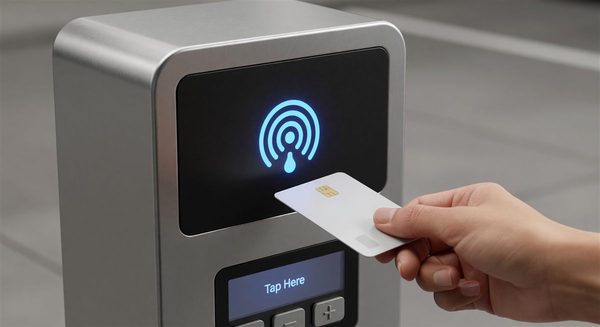
Before COVID-19, contactless payments at parking terminals were a luxury feature — present mostly at upmarket urban garages and airport facilities, largely invisible in surface lots and municipal meters. The pandemic changed the calculus overnight. In the 12 months following March 2020, operators across the U.S. reported a 40–60% drop in cash transactions at pay stations, a shift driven partly by hygiene concerns and partly by the acceleration of mobile wallet adoption among consumers who had started tapping everywhere else.
By 2022, EMV contactless (chip-and-tap) had become a baseline expectation in RFPs for new parking equipment rather than an optional add-on. EMVCo, the technical body that governs EMV specifications, reported that global EMV contactless transactions exceeded 45% of all card-present volume by late 2023 — a benchmark that parking has tracked, with a lag of roughly 18–24 months behind general retail (EMVCo Transaction Statistics).
By the close of 2025, industry estimates place contactless share of parking terminal transactions between 38% and 52% depending on market — urban dense markets skewing higher, rural surface lots still predominantly cash or mag-stripe. The Federal Reserve’s Payments Study has documented consistent year-over-year declines in cash and check payments across all consumer sectors, a macro trend that pushes parking operators even when they are not actively upgrading hardware (Federal Reserve Payments Study).
Where Parking Lags Retail Contactless Adoption
Walk into a major U.S. grocery chain today and you will find contactless acceptance rates above 70%. At most quick-service restaurants, tap-to-pay is the default checkout motion. Parking sits 15–25 percentage points behind those benchmarks, and the gap is structural rather than attitudinal.
Three factors account for the lag:
Hardware replacement cycles. Parking pay stations have useful lives of 10–15 years. A meter installed in 2015 may have been a leading-edge device at deployment but lacks the NFC radio and updated EMV kernel required for contactless. Operators have little incentive to replace functioning hardware on a retail-style 3-year cycle.
Network complexity. Parking payments traverse a chain of processors, validators, and parking management systems that each require EMV kernel certification. A contactless-capable terminal connected to a non-updated back office simply does not process tap transactions correctly. Retail chains own their POS stack end-to-end; parking operators typically integrate third-party hardware, processors, and management platforms from different vendors.
Session-start ambiguity. Unlike a retail transaction where the total is known before the card is presented, many parking sessions are open-ended — the driver does not know the final amount when they tap. This requires pre-authorization and completion flows that add complexity compared to a fixed-amount grocery checkout.
Transit Aggregate Transaction Models
The segment that has solved these problems most elegantly is urban transit. Agencies such as Transport for London, the New York MTA, and Chicago CTA have deployed open-loop EMV contactless fare collection at scale, processing millions of taps per day with average transaction times under 500 milliseconds.
The key innovation is the aggregate transaction model, sometimes called a “wave and pay” or “best fare” system. Instead of authorizing a single transaction at tap-in, the system accumulates all taps within a 24-hour or weekly window and settles a single debit to the card or mobile wallet at the end of the period. This approach resolves the open-session problem directly: no pre-authorization hold, no completion message at exit — just a consolidated settlement that fits neatly into standard card network rails.
Parking operators are beginning to adapt this logic, particularly in multi-entry garage environments. Some off-airport operators have implemented aggregate daily models where a driver taps in, taps out, and receives a single charge 2–4 hours after exit rather than a pre-auth at entry. The friction reduction is measurable: pilot programs have reported 8–12% increases in transaction completion rates compared to pre-auth flows, primarily by eliminating pre-authorization declines on debit cards with low available balances.
The transit model also provides a template for handling failed or disputed transactions without requiring an attendant. IPMI (the International Parking & Mobility Institute) has published guidance on adapting open-loop transit frameworks for gated parking facilities, noting that the biggest technical gap is the lack of a universal back-office standard comparable to what transit agencies use (IPMI — parking.org).
Mobile Wallet Share at the Parking Terminal
Apple Pay, Google Pay, and Samsung Pay collectively represent the fastest-growing segment of contactless parking transactions, even as their absolute share of terminal volume remains below 20% industry-wide. The growth rate matters more than the current number: mobile wallet transactions at parking terminals grew approximately 34% year-over-year in 2024 and are tracking similarly in 2025.
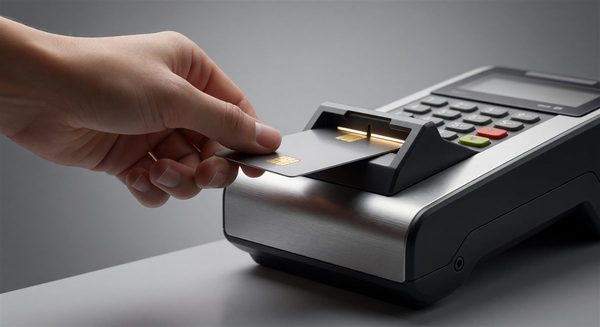
The distinction between card-based NFC and mobile wallet NFC is operationally significant. Both use the same ISO 14443 contactless interface, but mobile wallets add a device-based authentication layer (Face ID, fingerprint, PIN) that reduces chargeback rates substantially. Operators who have broken out mobile wallet transactions from physical contactless card transactions report chargeback rates on mobile wallet payments that are 60–80% lower — primarily because the biometric authentication step satisfies the cardholder verification requirement in a way that a tap-only card transaction does not.
Apple Pay dominates in markets where iPhone penetration is high — the U.S., Canada, UK, Australia. Google Pay leads in Android-majority markets across Europe and parts of Asia. Samsung Pay’s magnetic secure transmission (MST) capability, which allows it to emulate a mag-stripe at non-NFC terminals, has been valuable at older parking equipment but is being phased out as the company shifts its roadmap toward standard NFC.
QR-code-based mobile payments (common in app-pay scenarios) occupy a parallel lane. They are not contactless in the NFC sense, but they serve overlapping driver behavior — particularly for session extension and enforcement-integrated payments — and will be treated in the companion article on mobile parking payments.
Cost of Contactless Hardware Retrofit vs. New Install
The economics of contactless upgrades are more favorable than many operators assume, particularly when evaluated against a 3-to-5-year transaction volume projection rather than a point-in-time capital budget.
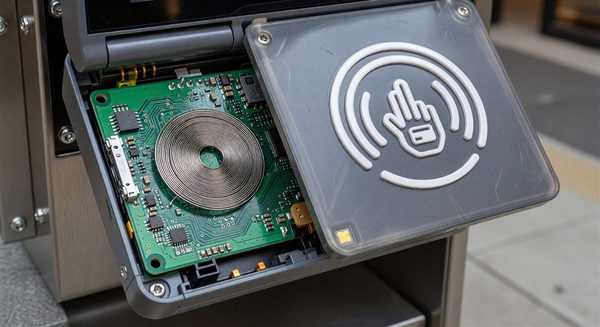
Retrofit. For pay stations manufactured after approximately 2018, an NFC/EMV contactless retrofit typically involves replacing the payment module (the hardware assembly containing the card reader, NFC antenna, and keypad) and updating the device firmware and EMV kernel. Module replacement costs vary by manufacturer but commonly fall in the $300–$700 range per unit, excluding installation labor. Processing certification — the EMV kernel validation required by card networks — adds time (4–12 weeks depending on the processor) but not typically direct cost to the operator.
New install. New pay stations from major manufacturers ship with contactless as standard. All-in per-space costs for a new single-space meter or multi-space pay station vary widely by configuration, but the contactless capability itself is no longer a cost premium — it is table stakes.
The business case inflection point. At roughly 200 or more contactless-eligible transactions per month per device, the reduction in cash handling costs (armored transport, vault fees, counting labor, counterfeit risk) alone typically offsets retrofit costs within 18–24 months. At facilities where cash handling accounts for $0.35–$0.65 per transaction in total cost, the math improves further. For a full framework covering throughput and chargeback savings, see the how parking payment systems work overview.
ROI Math: Throughput, Chargeback Reduction, Cash Handling
Operators evaluating contactless upgrades should model three distinct return streams rather than treating the investment as a pure cost center.
Throughput gains. Contactless transactions complete in 2–4 seconds at a well-configured terminal versus 8–12 seconds for a chip-and-PIN transaction and 15–25 seconds for cash. In high-volume facilities — airport exits, event egress lanes — throughput improvement directly reduces queue length and, consequently, labor costs for staffing overflow. A busy 1,000-space facility processing 600 exits in a 2-hour post-event window can see lane throughput increase by 20–30% with a shift from cash/PIN to contactless-primary.
Chargeback reduction. Industry-wide, parking faces above-average chargeback rates compared to most card-present retail categories. Mag-stripe transactions carry the highest dispute frequency; EMV chip-and-PIN reduces chargebacks substantially; EMV contactless with mobile wallet authentication reduces them further. An operator processing 50,000 card transactions per month at an average $12 ticket who reduces their chargeback rate from 0.35% to 0.12% eliminates roughly $138,000 in annual dispute losses and associated processing fees.
Cash handling elimination. Cash handling in parking is expensive in ways that rarely appear in a single line item. Armored courier contracts, coin counting equipment, vault reconciliation labor, till shortages, and counterfeit currency losses typically aggregate to $0.40–$0.65 per cash transaction. Facilities that shift from 60% cash to 20% cash on a base of 200,000 annual transactions recover $32,000–$52,000 annually from that reduction alone — before accounting for reduced attendant hours.
Combined model. A 500-space urban garage processing 250,000 annual transactions, shifting from 55% contactless to 85% contactless over a 24-month retrofit program, can realistically model $75,000–$120,000 in combined annual benefit. Against a $150,000–$200,000 retrofit capital cost, the payback window falls within 18–30 months for most facilities.
What’s Next: Open Loop Transit, Account-on-File, Tokenized Payments
The next phase of contactless evolution in parking is less about the tap interaction itself and more about what happens after it.
Open-loop transit integration. Several major U.S. transit agencies are expanding open-loop contactless acceptance to cover park-and-ride facilities, validating the same card or device used for the train fare against the parking fee. The driver taps once entering the garage, once at the fare gate, and receives a single settlement that can apply transit benefit rules or employer subsidies automatically. Visa and Mastercard have both published technical frameworks for combined transit and parking settlement, and pilot programs are active in the greater Chicago and Washington D.C. markets.
Account-on-file (AOF) models. Rather than processing a new card-present transaction at every visit, AOF models store a tokenized payment credential against a license plate or app account and charge it automatically at session close. The driver never touches a terminal. The transaction is card-not-present in network terms but is protected by the same EMV tokenization standards that govern device-based mobile wallets. For more on the EMV tokenization layer, the EMV contactless payments in parking article covers the specification in detail.
Payment tokenization and credential-on-file security. PCI DSS 4.0, which became mandatory in March 2024, imposes stricter requirements on how parking operators store and transmit payment credentials. The shift to tokenized AOF models — where the actual card PAN never touches the operator’s system — is both a compliance response and a security upgrade. Processors and network tokens issued by Visa Token Service and Mastercard Digital Enablement Service are now available to parking-specific technology platforms, bringing parking operators onto the same credential-on-file infrastructure used by e-commerce platforms.
Further Reading
The contactless shift in parking is accelerating, but it is uneven — and the operators who close the gap first will accumulate compounding advantages in throughput, chargeback economics, and driver experience scores. The trajectory from tap-at-terminal to invisible, license-plate-triggered settlement is clear; the timeline to industry-wide adoption depends largely on hardware refresh cycles and back-office standardization.
For deeper dives on adjacent topics, the following articles provide additional context:
- EMV Contactless Payments in Parking — How the Standard Works
- Mobile Parking Payments — Apps, QR Codes, and Wallet Integration
- How Parking Payment Systems Work — End-to-End Transaction Flow
For industry standards and data referenced in this article, see EMVCo, the Federal Reserve Payments Study, and IPMI at parking.org.