A parking management system is the integrated hardware and software that controls vehicle access, automates payment, and tracks occupancy across a parking facility — combining barrier gates, pay stations, ticket dispensers or license-plate-recognition (LPR) cameras, and cloud software on a single platform. It replaces manual ticketing and cash collection with an automated workflow that records every entry, calculates fees, processes payment, and reports revenue in near-real time.
The term is sometimes used interchangeably with “parking access and revenue control system” (PARCS), the older industry label for the gated equipment at a garage entrance and exit. In current usage, a parking management system is broader: it spans the physical lane equipment and the software layer that configures rates, manages permits, and consolidates reporting across one or many sites.
What is a parking management system?
A parking management system is a coordinated set of devices and software that automates how a facility admits vehicles, charges for parking, and accounts for the revenue. At minimum it identifies each parking session — by paper ticket, QR code, or license plate — calculates what is owed based on a rate schedule, accepts payment, and opens a barrier or logs an exit. Everything else (occupancy counts, validations, permits, analytics) is built on top of that core loop.
The purpose is threefold: reduce the labor cost of collecting parking revenue, prevent revenue leakage from unrecorded or underpaid sessions, and give operators data they did not have under a cash-and-attendant model. The International Parking & Mobility Institute tracks the technology shift driving this adoption through its annual surveys and conference programming.
What are the components of a parking management system?
A parking management system has five functional components. Field hardware admits and charges vehicles; software configures and reports on it; and integrations connect it to the wider operation.
- Entry and exit terminals — devices at the lane that issue a credential (a ticket or QR code) or read a license plate, and that trigger the barrier on a valid, paid session.
- Barrier gates — the electromechanical arms that physically control vehicle flow, rated by cycle life and opening speed.
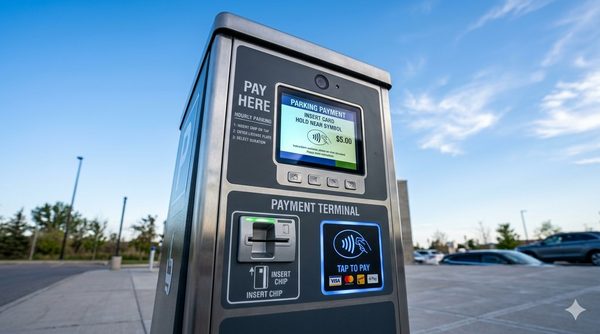
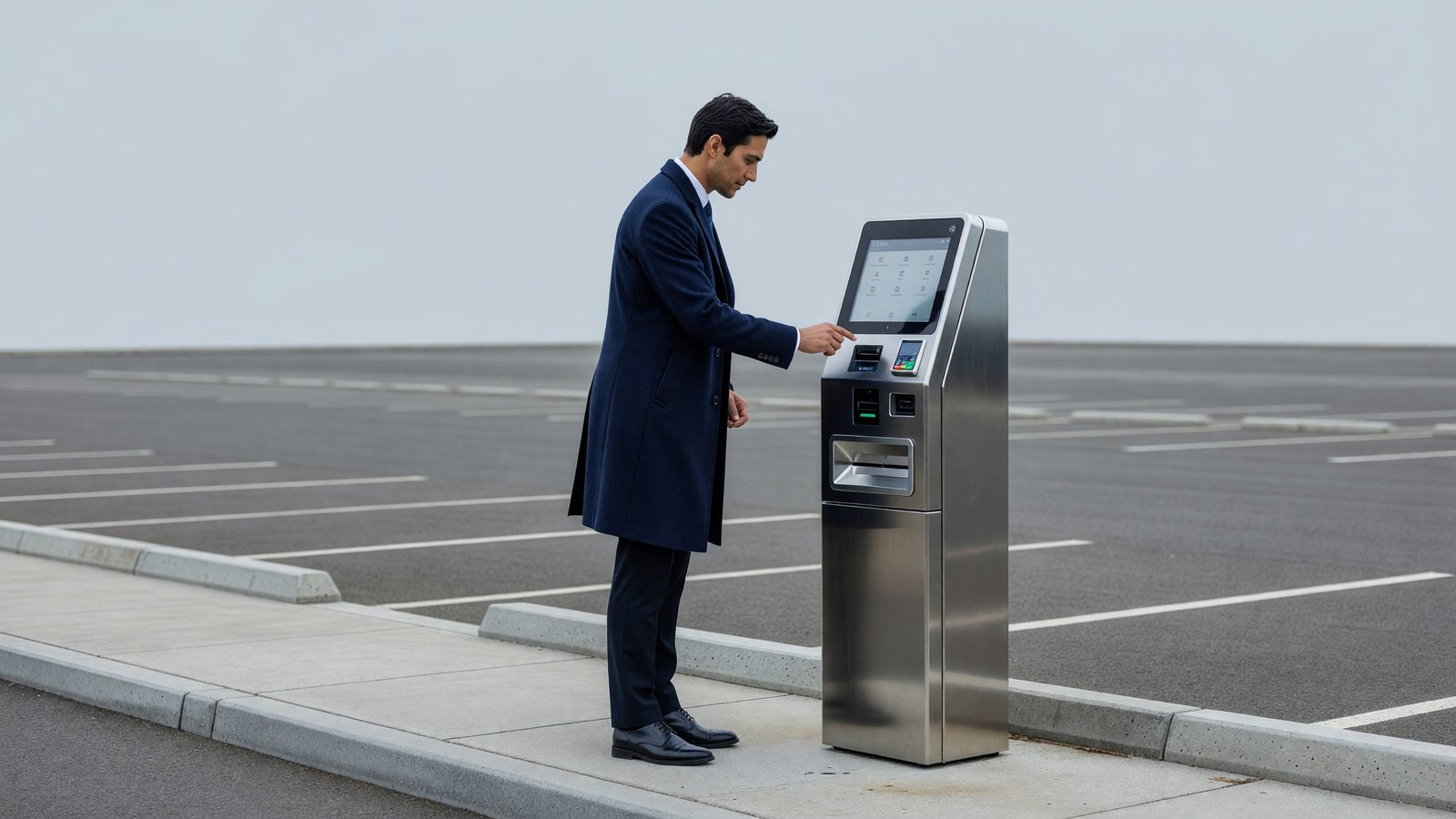
- Pay stations — pay-on-foot or pay-in-lane units that calculate the fee and accept cards, contactless, mobile wallets, and sometimes cash.
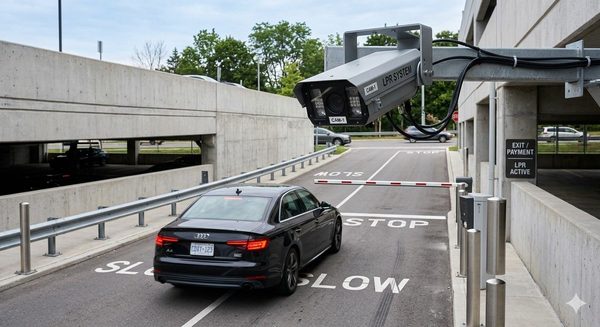
- License-plate-recognition (LPR) cameras — optional cameras that read plates for plate-based access, enforcement, or as a backup identifier alongside a ticket.
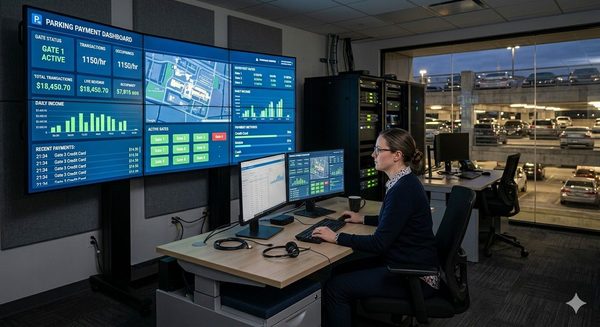
- Management software — the platform, increasingly cloud-hosted, where operators set rates, issue permits, monitor device health, and run revenue and occupancy reports.
For a layer-by-layer walkthrough of how these pieces connect during a live transaction, see How Parking Payment Systems Work: Architecture and Data Flow.
How does a parking management system work?
A parking management system works as a five-step loop: entry, credential, payment, exit, and reporting. The system identifies the vehicle at entry, holds the session open, settles payment, verifies that payment before release, and records the completed transaction for accounting.
- Entry. A vehicle arrives. The entry terminal issues a ticket or QR code, or an LPR camera captures the plate, and the barrier lifts. The session is logged with a timestamp.
- Credential. The ticket, code, or plate becomes the identifier that links the entry event to the eventual payment.
- Payment. The parker pays — at a pay-on-foot station inside the facility, at the exit lane, or through a mobile app or pre-booking. The rate engine calculates the fee from the entry and exit times and the rate schedule.
- Exit. At the exit terminal, the system confirms the session is paid (within any grace period) and opens the barrier. Plate-based facilities match the exit plate to a paid session with no paper involved.
- Reporting. The completed transaction syncs to the management platform, where it updates revenue totals, occupancy counts, and payment-method breakdowns.
Card payments inside this loop follow the security standards maintained by the PCI Security Standards Council, and the contactless and chip transactions at the terminal conform to the specifications published by EMVCo.
What are the types of parking management systems?
There are four broad types of parking management system: gated (PARCS), plate-based (LPR), software-only, and hybrid. They differ mainly in how a vehicle is identified and whether a physical barrier is used.
- Gated / PARCS. Barrier gates at entry and exit enforce payment physically. A vehicle cannot leave until the session is paid. This is the traditional model for structured garages and high-revenue facilities where enforcement certainty matters most.
- Plate-based / LPR. Cameras read license plates as the session identifier, often with no paper ticket and sometimes with no barrier (“free-flow”). Enforcement shifts from a physical gate to billing, permits, and citations.
- Software-only. No on-site access hardware at all — parkers pay through a mobile app or pay-by-plate web page, and enforcement is handled by roving staff or LPR enforcement vehicles. Common on-street and in surface lots.
- Hybrid. A mix — for example, gated lanes for transient parkers plus LPR for monthly permit holders, or barriers at entry with app-based payment. Most large operators run some hybrid of the above.
How much does a parking management system cost?
A parking management system typically costs from roughly $15,000 to $40,000 for a single entry-and-exit gated lane with a pay station, installed, and $80,000 to $150,000 or more for a multi-lane garage with LPR and pay-on-foot stations. These figures are directional and vary widely by site conditions, integration scope, and vendor — operators should treat any published range as a starting point and request itemized quotes.
Other cost references worth knowing:
- Per space. The U.S. Department of Transportation’s ITS deployment evaluation knowledge base has cited advanced parking management systems at roughly $250 to $800 per parking space to install, though that benchmark is dated and skews toward guidance and detection systems rather than gated revenue control.
- Software licensing. Cloud platform fees commonly run from a few hundred dollars per lane per year for basic configurations to several thousand for enterprise, multi-site deployments.
- Total cost of ownership. Hardware is only the first line item. Maintenance, service calls, payment processing fees, software subscriptions, and consumables (paper tickets, where used) accumulate over an eight-to-twelve-year equipment life.
For a structured way to compare systems on total cost of ownership rather than sticker price, see the Parking Payment Systems: Complete Buyer’s Guide.
Parking management system vs. parking management software — what’s the difference?
A parking management system is the complete package of hardware and software; parking management software is the platform layer alone. The software configures rates, manages permits, monitors devices, and produces reports, but on its own it does not admit a vehicle or accept a card at the lane — it needs terminals, gates, cameras, or pay stations to act on.
The distinction matters when buying. A software-only product may integrate with hardware you already own, or may assume an app-and-enforcement model with no lane equipment at all. A full system bundles both, usually from one manufacturer, with a defined responsibility line for support. Clarifying which one a vendor is selling — and what it does and does not include — avoids a common procurement misunderstanding.
Who makes parking management systems?
Parking management systems are made by a mix of global and North American manufacturers, including SKIDATA, Scheidt & Bachmann, TIBA, T2 Systems, Amano McGann, HUB Parking, Flowbird, IPS Group, and Parking BOXX. Some specialize in large structured-garage PARCS, others in on-street and surface-lot equipment, and several now build cloud-first, plate-based platforms.
Manufacturers differ in how much they build in-house versus assemble from third-party parts. Parking BOXX, for example, is a North American manufacturer that designs its access and payment hardware and develops its CloudEASE management software in-house — an integrated hardware-plus-software model, as opposed to vendors that pair their gates with a separately licensed platform. When evaluating any maker, it is worth confirming whether the hardware and software come from one source or several, because that determines who is accountable when something fails.
Beyond the manufacturers, the National Parking Association and IPMI publish operator-facing benchmarks and vendor directories that are useful neutral starting points for building a shortlist.
How to choose a parking management system
Choosing a parking management system comes down to matching the type to your enforcement needs, your transaction volume, and your appetite for on-site hardware. A few questions narrow the field quickly:
- Do you need physical enforcement? High-revenue garages usually want gated PARCS; low-risk surface lots may do fine with software-only or LPR.
- What is your peak throughput? Lane count and terminal speed must absorb your busiest hour without backing up traffic.
- Cloud or on-premise? Cloud platforms simplify multi-site management and updates; on-premise or edge-capable systems add resilience when connectivity drops.
- Open or closed? Open APIs let you integrate LPR, mobile, and accounting tools later; closed ecosystems lock you into one vendor’s modules.
- Who owns the data and the compliance? Confirm data access and the PCI responsibility split before signing.
Frequently Asked Questions
What is a parking management system?
A parking management system is the integrated hardware and software that controls vehicle access, automates payment, and tracks occupancy across a parking facility. It combines barrier gates, pay stations, ticket dispensers or LPR cameras, and management software on one platform to record every session and account for revenue automatically.
What are the main components of a parking management system?
The main components are entry and exit terminals, barrier gates, pay stations, license-plate-recognition cameras, and management software. The terminals and cameras identify each session, the pay stations collect payment, the gates enforce it physically, and the software configures rates and consolidates reporting across one or more sites.
What is the difference between a parking management system and PARCS?
PARCS, or parking access and revenue control system, traditionally refers to the gated lane equipment at a garage. Parking management system is the broader, current term that covers that lane hardware plus the software layer for rates, permits, occupancy, and reporting. In practice the terms overlap, but a parking management system implies the full hardware-and-software platform.
How much does a parking management system cost?
A single gated entry-and-exit lane with a pay station typically runs about $15,000 to $40,000 installed, while a multi-lane garage with LPR and pay-on-foot stations can reach $80,000 to $150,000 or more. Software licensing and ongoing maintenance add recurring cost, so operators should compare total cost of ownership, not just hardware price.
Do parking management systems still use paper tickets?
Not necessarily. Plate-based and LPR systems identify vehicles by license plate and can operate with no paper tickets at all, billing through accounts, permits, or pay-by-plate. Many facilities still issue tickets or QR codes for transient parkers, and hybrid setups mix paper, mobile, and plate-based credentials depending on the parker type.
How a parking management system fits the wider operation
A parking management system rarely operates alone. It typically integrates with building access control, mobile and reservation platforms, EV charging, and accounting or ERP software, so that one transaction record can flow into revenue recognition and one credential can open both a gate and a tenant door. Treating the system as part of the facility’s broader technology stack — rather than an isolated piece of lane equipment — is what separates a smooth deployment from a decade of integration headaches.