Selecting a parking payment system is one of the most consequential decisions a facility owner or operator will make. The hardware typically lasts eight to twelve years, the software contract locks in recurring costs, and the payment experience shapes every visitor’s impression of your property. Get it right and you reduce labor costs, accelerate throughput, and open new revenue channels. Get it wrong and you inherit a decade of maintenance headaches and frustrated parkers.
This guide walks through the major system categories, the features that matter most in 2026, total-cost-of-ownership considerations, and the evaluation framework that procurement teams are using right now.
What Counts as a “Parking Payment System”?
The term is broad on purpose. A parking payment system is any combination of hardware and software that collects revenue from parkers. That can be as simple as a coin-operated meter on a city block or as complex as a multi-lane gated facility with license-plate recognition, mobile pay, and real-time occupancy dashboards.
For this guide, we focus on off-street systems — garages, surface lots, and mixed-use facilities — where the buyer is choosing equipment from a manufacturer or integrator. If you need a primer on the underlying technology first, see How Parking Payment Systems Work: Architecture and Data Flow, or step back to the broader category in What Is a Parking Management System?.
Major System Categories
Pay-on-Foot Stations
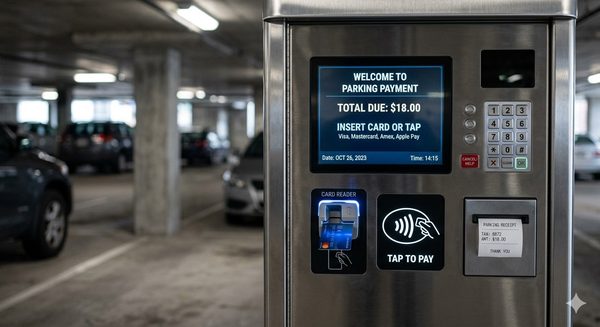
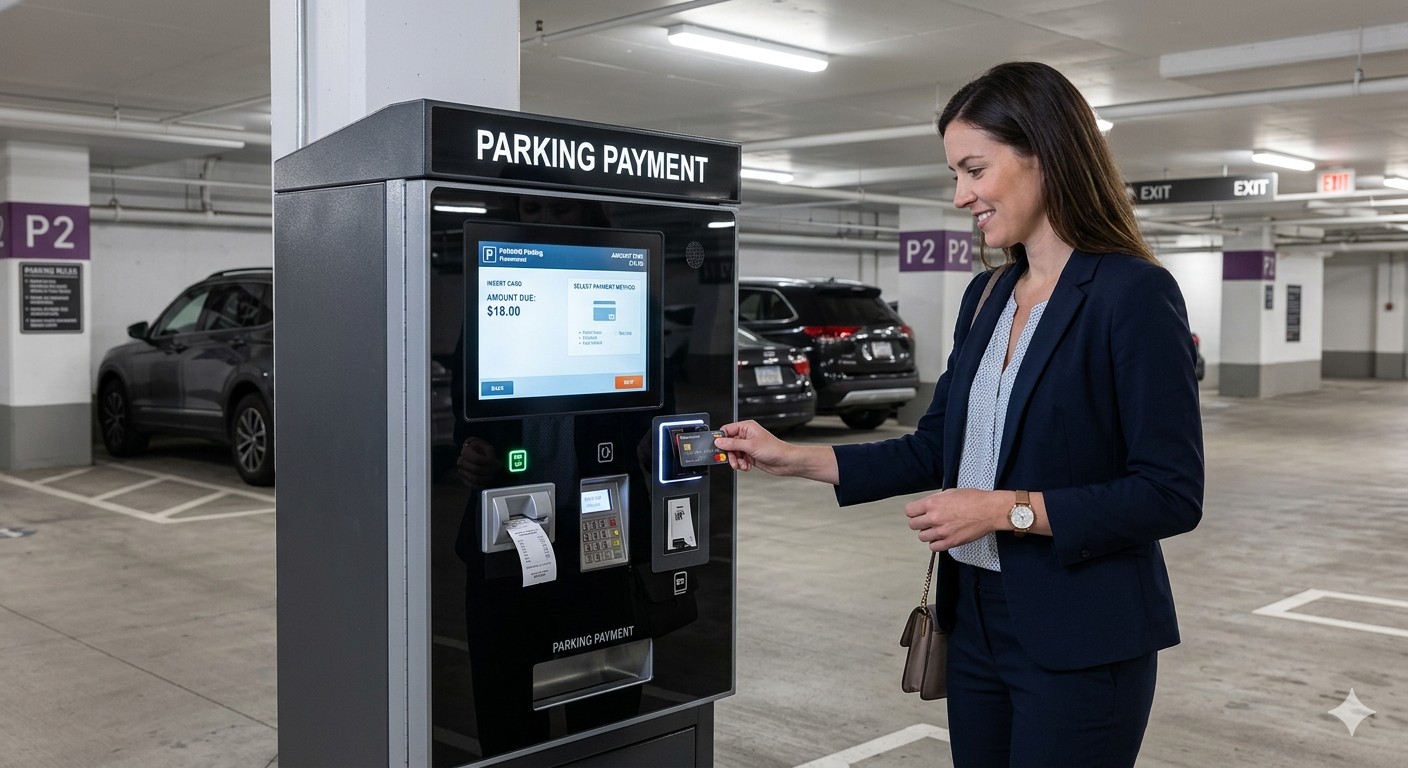
Pay-on-foot (POF) stations sit inside the facility, usually near elevators or pedestrian exits. Parkers insert their ticket (or scan a barcode), pay, and then have a grace period to drive out. This model keeps exit lanes moving because the transaction is already complete.
Pay-in-Lane / Exit Stations
Here, payment happens at the exit barrier itself. The driver stops, pays, and the gate lifts. Pay-in-lane is simpler to install (fewer devices) but can create bottlenecks during peak egress.
Pay-by-Phone and Mobile Wallets
Mobile-first systems let parkers pay via an app, QR code, or text message. These can supplement or, in some facilities, fully replace physical kiosks.
License-Plate-Recognition-Based (Gateless)
LPR systems photograph plates on entry and exit, calculate the fee, and collect payment through a pre-registered account, mobile app, or pay station. Barriers are optional, which reduces hardware costs but introduces enforcement complexity.
Feature Comparison Table
| Feature | Pay-on-Foot | Pay-in-Lane | Mobile / App | LPR Gateless |
|---|---|---|---|---|
| Payment before exit | Yes | No | Yes | Yes |
| Exit lane speed | Fast | Moderate | Fast | Fastest |
| Hardware per lane | Low (shared) | 1 per exit lane | None at lane | Camera only |
| Cash acceptance | Yes (optional) | Yes | No | No |
| Installation complexity | Moderate | Low | Low | Moderate |
| Best for | Garages, events | Small lots | Urban, mixed-use | High-volume, modern |
Features That Matter in 2026
EMV and Contactless Payment
Every system you evaluate should support EMV chip-and-PIN plus contactless (NFC) transactions. The EMV Migration Forum has published updated specifications for unattended terminals, and PCI SSC requirements now mandate point-to-point encryption on new deployments. If a vendor is still shipping magstripe-only readers, walk away.
Cloud Connectivity and Remote Management
Cloud-connected systems let operators monitor transactions, push rate changes, and diagnose faults from a browser. This is no longer a premium add-on — it is table stakes. Compare whether the vendor’s cloud platform charges per device, per transaction, or a flat monthly fee, because those models diverge sharply at scale.
Multi-Space Meter Compatibility
Some manufacturers offer pay stations that also manage on-street multi-space meters from the same back-end. If you operate both on- and off-street assets, consolidating onto one platform reduces training and reporting overhead.
Validation and Third-Party Integrations
Retail tenants, hospital systems, and event promoters all expect validation programs. Check whether the system supports digital validation (QR codes, mobile links) in addition to old-school stamp tickets. Integration with property management, POS, and access-control platforms is equally important.
ADA and Accessibility Compliance
All customer-facing units must meet ADA reach-range requirements and offer accessible payment paths. Look for Braille labels, high-contrast screens, audio guidance, and wheelchair-height card readers. European buyers should verify EN 301 549 compliance as well.
Leading Manufacturers to Evaluate
The market has consolidated over the past five years, but several strong competitors remain. Below is a representative (not exhaustive) list of vendors frequently shortlisted in North American and European procurements:
- Flowbird — Broad portfolio spanning on-street meters and off-street pay stations; strong mobile platform.
- Hectronic — German-engineered hardware popular in European municipal deployments.
- Scheidt & Bachmann — Full PARCS suites for airports, hospitals, and large commercial garages.
- Skidata — Widely deployed in ski resorts, stadiums, and mixed-use properties; strong access-control integration.
- T2 Systems — Software-centric platform popular with universities and municipalities.
Request demonstrations from at least three vendors before narrowing to a shortlist. Insist on seeing the back-office dashboard, not just the customer-facing kiosk.
Total Cost of Ownership
Purchase price is the most visible number and the least useful predictor of long-term cost. A complete TCO analysis should include the following line items.
Hardware and Installation
| Cost Component | Typical Range (USD) |
|---|---|
| Pay-on-foot station (per unit) | $18,000 – $45,000 |
| Entry / exit terminal (per lane) | $8,000 – $22,000 |
| LPR camera (per lane) | $3,000 – $8,000 |
| Barrier gate (per lane) | $2,500 – $6,000 |
| Network infrastructure | $5,000 – $20,000 |
| Installation labor | 15 – 25 % of hardware |
Recurring Costs
- Software licensing or SaaS fees: $150 – $800 per device per month depending on the platform.
- Payment processing: Typically 2.5 – 3.5 % plus a per-transaction fee. Negotiate interchange-plus pricing rather than flat-rate if your volume exceeds 5,000 transactions per month.
- Maintenance contracts: Budget 8 – 12 % of hardware cost annually for preventive maintenance and parts.
- Cash handling: Armored car pickups, coin and bill replenishment, and reconciliation labor. This line item alone can justify a cashless conversion in low-cash markets.
Hidden Costs to Watch
- Proprietary consumables — Some vendors lock you into branded receipt paper, ticket stock, or coin cassettes.
- API access fees — If you want to feed data into your own BI tools, confirm that API access is included.
- End-of-life firmware — Ask how long the vendor commits to security patches after the initial sale.
- Payment terminal certification renewals — EMV certifications expire; clarify who bears the re-certification cost.
Evaluation Framework
Use a weighted scorecard to keep the decision structured. Here is a starting template:
| Criterion | Weight | Notes |
|---|---|---|
| Payment method coverage | 20 % | EMV, contactless, mobile, cash, fleet cards |
| Cloud management capability | 15 % | Remote diagnostics, OTA updates, real-time dashboards |
| Total cost of ownership (10 yr) | 20 % | Hardware + software + processing + maintenance |
| Vendor stability and references | 15 % | Years in market, installed base, reference customers |
| Integration ecosystem | 10 % | Validation, access control, PMS, LPR |
| ADA / accessibility | 10 % | Compliance with current standards |
| Warranty and SLA terms | 10 % | Response times, parts availability, uptime guarantees |
Score each vendor on a 1-to-5 scale per criterion, multiply by weight, and sum. The numbers will not make the decision for you, but they will surface where vendors genuinely differ.
Common Procurement Mistakes
- Buying on price alone. The cheapest system frequently carries the highest maintenance and processing fees.
- Ignoring the software roadmap. Hardware is static; software determines whether the system stays current. Ask for a two-year product roadmap.
- Skipping the site survey. Every facility has unique power, network, and structural constraints. A thorough pre-installation survey prevents costly change orders.
- Overlooking training. Budget for on-site operator training and insist on documentation in your language.
- Single-vendor lock-in without exit terms. Ensure the contract specifies data portability and reasonable termination provisions.
When to Upgrade vs. Retrofit
Not every aging system needs a full rip-and-replace. Many vendors offer retrofit kits that add contactless readers, cloud connectivity, or LPR cameras to existing infrastructure. A retrofit makes sense when:
- The core hardware (gates, cabinets, displays) is still mechanically sound.
- The back-end software can accept new peripherals via open APIs.
- The payback period on a retrofit is under three years.
If the existing system is proprietary to the point that no third-party peripherals can connect, a full replacement is likely the better investment.
Questions to Ask Every Vendor
- What is the average uptime across your installed base?
- How are firmware and security patches delivered?
- Can we use a third-party payment processor, or are we locked into yours?
- What data do we own, and in what format can we export it?
- How does your system handle network outages — can it process payments offline?
- What does the migration path look like if we outgrow this platform?
The International Parking & Mobility Institute (IPMI) publishes procurement templates and case studies that can supplement your internal evaluation. For hardware-specific considerations, our guide on what to look for in parking payment machines covers the physical specifications in detail.
Key Takeaways
- A parking payment system purchase is a 10-year commitment. Prioritize total cost of ownership over sticker price.
- EMV, contactless, and cloud management are non-negotiable features in 2026.
- Evaluate at least three vendors using a weighted scorecard to keep comparisons objective.
- Budget for recurring costs — software licensing, payment processing, and maintenance — which often exceed the initial hardware investment over the system’s lifetime.
- Insist on data portability, open APIs, and clear end-of-life commitments before signing.
The market is mature enough that no single vendor dominates every use case. The right system is the one that fits your facility’s traffic patterns, payment mix, and operational capacity — not the one with the flashiest demo.