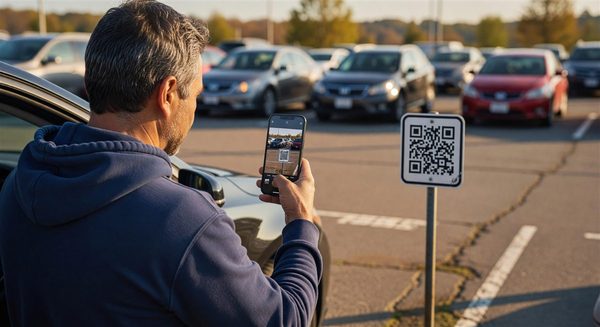
Six years ago, mobile wallet adoption in parking payments was a rounding error. Industry data collection efforts in 2020 suggested contactless mobile transactions made up less than 3% of total card transactions at North American parking pay stations. By mid-2025, published operator data and processor aggregate statistics place that number between 35% and 55% depending on facility type.
That kind of shift is rare enough that it’s worth examining honestly rather than celebrating. The migration has consequences for hardware specifications, customer experience design, and compliance practice that the industry is still working through.
The Growth Curve, With Caveats
Published deployment data from major operators and processor aggregate reports paint a consistent picture:
- 2020: 2-5% of card transactions at mobile-enabled terminals
- 2021: 8-12% — pandemic-driven contactless preference accelerated adoption
- 2022: 18-25%
- 2023: 28-35%
- 2024: 35-45%
- 2025 (projected): 40-55%
The ranges are wide because facility type dominates the variance. Airport long-term parking now runs 55-65% mobile wallet on contactless-equipped terminals. Municipal meter replacements show 30-40%. Urban downtown garages fall between. The facility type matters because customer demographics differ: business travelers at airports overwhelmingly have mobile wallets configured; suburban shoppers often don’t.
What Drove the Shift
Three factors combined to produce growth this fast:
iOS and Android default experience changes. Starting around 2021, both platforms made wallet access more prominent — lock-screen double-tap, lock-screen payment gesture — which substantially reduced the friction of initiating a mobile wallet transaction versus pulling out a physical card.
Contactless limit increases. Card scheme mandates raised contactless transaction limits repeatedly between 2020 and 2023. A typical parking transaction of $8-25 fell well within contactless limits throughout the period, but the mandate-driven adjustments signaled operator confidence in the technology.
Terminal capability catch-up. By 2023, the vast majority of newly installed pay stations supported contactless, and the installed base was rapidly turning over. By 2025, there are fewer terminals without contactless than with it.
What the Data Doesn’t Say
Mobile wallet statistics don’t distinguish between “customer preferred to use Apple Pay over their physical card” and “customer forgot their physical wallet and only had the phone.” The former represents genuine preference; the latter represents availability. Both show up as mobile wallet transactions.
Customer surveys conducted by academic researchers suggest the split is roughly 70/30 preference/availability, but the surveys have methodological limitations. Operators should treat the adoption numbers as demonstrated contactless capability rather than demonstrated preference.
Hardware Implications
The shift has pushed several hardware specification considerations:
NFC antenna placement and strength. Early contactless-enabled terminals had antennas sized and positioned for card taps. Phone taps occur from greater distances and at more varied angles. Terminals with undersized antennas produce high rates of customer confusion (multiple taps required, transaction abandonment). Replacement programs have increasingly specified larger antennas.
Screen prompting changes. Customers who tap their phone expect different feedback than customers who insert a card. Terminals optimized for card use often handle the mobile wallet UX poorly — unclear when the tap was successful, unclear what to do next. Firmware updates are typically sufficient to address this, but not all terminals get them.
Transaction timing. Mobile wallet transactions are typically faster end-to-end than card transactions because the tokenization happens on the device before the tap. Facilities with capacity constraints at exit lanes have seen meaningful throughput gains from encouraging mobile wallet use through UX design.
Compliance Considerations
Mobile wallet transactions have the same PCI DSS scope as other tokenized card transactions in most cases — the operator receives a token, not a PAN. But the specific data flows vary by platform, and operators should confirm with their processor that the Responsibility Matrix covers Apple Pay and Google Pay flows specifically, not just generic contactless.
Several large operators have learned this the hard way after audits flagged gaps in their documented scope for wallet-specific flows. The fix is usually documentation, not implementation changes, but it can be disruptive if discovered late.
Frequently Asked Questions
Does mobile wallet carry different interchange rates?
Sometimes. Apple Pay and Google Pay transactions are tokenized through the card scheme networks and typically carry the same interchange as the underlying card. Some processors apply surcharges; some don’t. The economics vary enough that operators should audit their processor statements specifically for wallet versus physical card rates.
What about closed-loop mobile payment apps?
PayByPhone, ParkMobile, and similar apps operate on different economic models — typically with their own merchant account and a revenue share back to the operator. These should be evaluated separately from open-loop mobile wallet statistics. They’re often complementary (mobile apps for subscription-style parking, open-loop wallets for transient parking) but the transaction economics are distinct.
Has mobile wallet adoption stabilized or will it continue growing?
Current trajectory suggests continued growth through 2027, with saturation likely at 65-75% in facility types with favorable demographics. Below that ceiling, physical cards and cash will persist as meaningful minority transaction types for the foreseeable future. Facilities assuming they can go “mobile only” are still premature.
Do older customers use mobile wallets?
More than stereotypes suggest. Published demographic data shows adoption rates among customers 55+ growing faster than any other age cohort in 2023-2025, though absolute rates remain lower than among younger cohorts. Designing the experience to accommodate both mobile wallet and physical card users remains the correct approach regardless of target demographic.