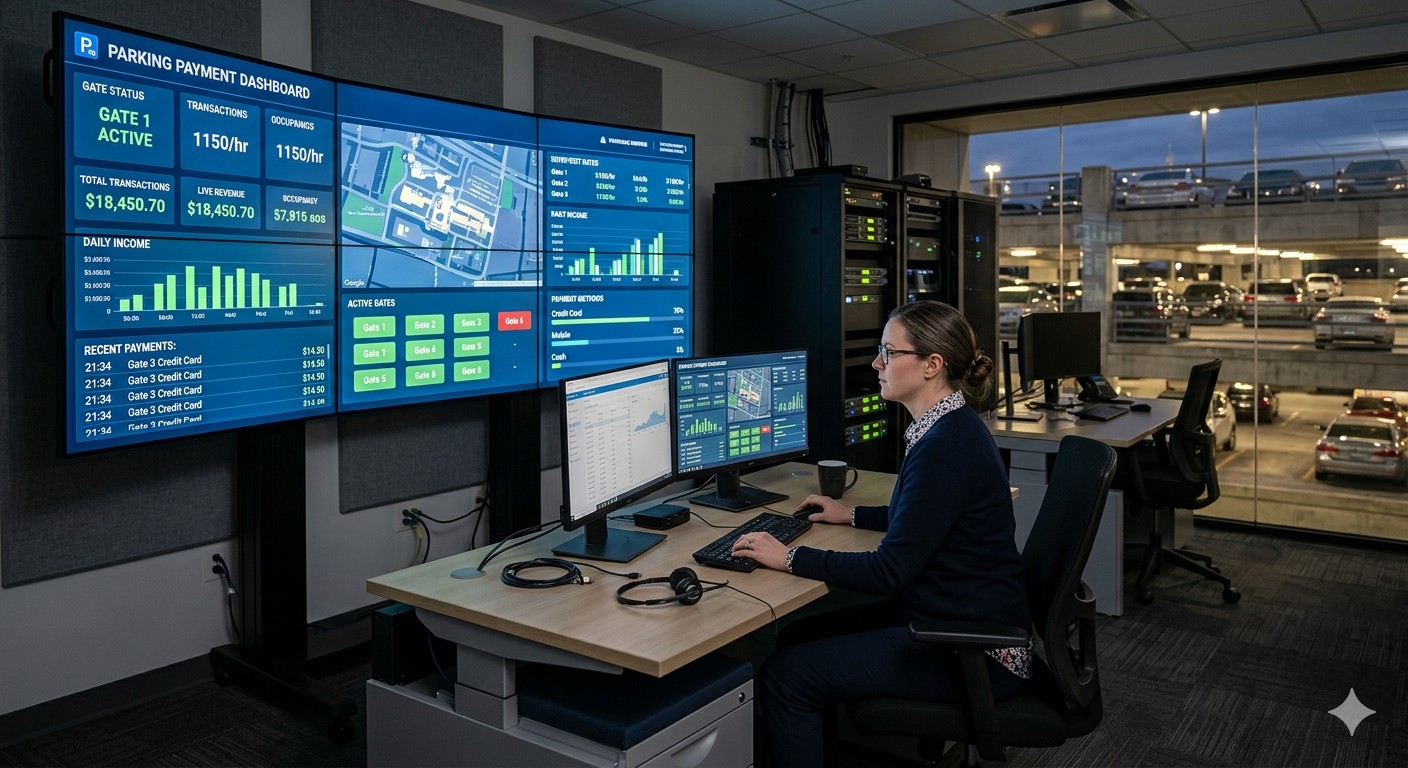
Parking payment systems look simple from the outside: a driver enters, parks, pays, and leaves. Behind that four-step experience is a layered architecture that coordinates physical devices, embedded software, payment networks, back-office databases, and increasingly, cloud services. Understanding how these layers connect helps operators make better purchasing decisions, diagnose problems faster, and evaluate vendors with sharper questions.
This article maps the architecture of a modern parking access and revenue control system (PARCS) from the ground up. For a plain-language primer on the broader category first, see What Is a Parking Management System?.
The Five Layers of a PARCS Architecture
Every parking payment system, regardless of manufacturer, can be decomposed into five functional layers:
- Field devices — The hardware parkers interact with: entry terminals, exit terminals, pay stations, gates, cameras, and sensors.
- Local controller — The on-site computer (or embedded processor) that manages device communication, rate calculations, and offline transaction queuing.
- Payment processing — The middleware and network connections that route card transactions to acquiring banks and payment networks.
- Management platform — The software operators use to configure rates, monitor activity, run reports, and manage access credentials.
- Integrations — Connections to external systems such as access control, property management, LPR engines, mobile apps, and accounting software.
The diagram below shows how data flows through these layers during a typical garage transaction.
Simplified Data Flow
Parker arrives
  → Entry terminal reads ticket / LPR captures plate
    → Local controller logs entry event
      → Entry data stored in local database

Parker pays at pay-on-foot station
  → Station calculates fee (rate engine)
    → Card inserted / tapped
      → Payment terminal encrypts card data
        → Transaction routed to payment processor
          → Acquirer → Card network → Issuing bank
            → Approval returned
              → Station prints receipt, updates ticket status

Parker exits
  → Exit terminal reads ticket / LPR matches plate
    → Local controller verifies payment
      → Gate opens
        → Exit event logged
          → Transaction synced to cloud management platform
Each step in this chain has failure modes, fallback behaviors, and security requirements. Let’s walk through the critical ones.
Layer 1: Field Devices
Entry Terminals
The entry terminal’s job is to assign an identifier to the parking session. Depending on the system, this identifier might be:
- A paper ticket with a barcode or magnetic stripe
- A QR code displayed on the parker’s phone
- A license plate number captured by an LPR camera
- An RFID or Bluetooth signal from a transponder
Modern entry terminals from manufacturers like Scheidt & Bachmann, Skidata, and Flowbird typically support multiple identification methods simultaneously — ticket plus LPR, for example — so the system can fall back to one if the other fails.
Pay Stations
Pay stations are the most complex field devices. A full-featured pay-on-foot unit contains:
| Component | Function |
|---|---|
| Ticket reader (barcode / magstripe) | Identifies the parking session |
| EMV card reader | Accepts chip-and-PIN and contactless payments |
| Bill acceptor | Accepts cash (optional) |
| Coin acceptor / dispenser | Accepts and returns coins (optional) |
| Bill recycler or dispenser | Returns change in bills (optional) |
| Touchscreen display | Guides the parker through payment |
| Receipt printer | Issues proof of payment |
| Intercom / camera | Connects to remote support |
| Network interface | Communicates with local controller and cloud |
The physical design varies by manufacturer. Flowbird and Hectronic favor compact, modular enclosures suited for on-street and small-lot deployments. Scheidt & Bachmann and Skidata build larger units for high-volume garages. T2 Systems, IPS Group, and Parking BOXX occupy a middle ground aimed at the North American commercial and municipal market.
Exit Terminals
Exit terminals validate that payment is complete and trigger the barrier gate. In a ticket-based system, the exit terminal reads the ticket’s barcode and checks the local database for a matching paid transaction. In an LPR system, the exit camera captures the plate and the controller matches it against paid sessions.
Barrier Gates
Gates are electromechanical devices rated by cycle count (typically 1 to 5 million cycles), arm length, and opening speed. They receive a simple open/close signal from the controller. High-speed gates can open in under one second, which matters for facilities processing 500+ vehicles per hour per lane.
Layer 2: Local Controller
The local controller is the brain of the on-site system. It runs the rate engine, manages device communication, and maintains a transaction database. In older systems, this is a dedicated industrial PC in a server room. In newer architectures, the controller logic is embedded in the pay station or runs as a virtual machine on commodity hardware.
Rate Engine
The rate engine calculates what a parker owes based on:
- Entry and exit timestamps
- The rate schedule in effect (which may vary by time of day, day of week, event status, or parker type)
- Validations applied (retailer discounts, employee rates, hospital patient rates)
- Maximum daily caps or grace periods
Rate engines range from simple (flat rate per hour) to extraordinarily complex (tiered progressive rates with early-bird specials, event overlays, and dynamic pricing). The sophistication of the rate engine is one of the primary differentiators between entry-level and enterprise PARCS platforms.
Offline Operation
A well-designed local controller can continue processing transactions even when the network connection to the cloud management platform drops. This is critical. A parking garage cannot stop collecting revenue because the internet went down.
Offline capabilities to verify during evaluation:
- Can the pay station process credit card transactions offline? (Most can, using store-and-forward, but daily limits apply.)
- Does the rate engine function without cloud connectivity?
- How does the system reconcile transactions once connectivity is restored?
Layer 3: Payment Processing
The Transaction Path
When a parker taps or inserts a credit card at a pay station, the transaction follows a well-defined path governed by PCI DSS standards:
- Card data capture. The EMV reader captures card data and generates a cryptogram unique to the transaction.
- Point-to-point encryption (P2PE). The card data is encrypted at the reader before it reaches the pay station’s processor. This limits the pay station’s PCI scope.
- Transaction routing. The encrypted data is sent to a payment gateway, which routes it to the acquiring bank.
- Authorization. The acquiring bank forwards the transaction to the card network (Visa, Mastercard, Amex), which routes it to the issuing bank for approval.
- Response. An approval or decline code travels the reverse path back to the pay station, typically in two to four seconds.
- Settlement. At the end of the day, authorized transactions are batched and settled, with funds deposited into the operator’s merchant account.
Payment Methods Beyond Cards
Modern systems also handle:
- Mobile wallets (Apple Pay, Google Pay) — processed as contactless EMV transactions at the reader.
- QR-code payments — the parker scans a code, pays on their phone, and the system receives confirmation via API.
- Fleet cards and fuel cards — require specific BIN ranges and may route through dedicated networks.
- Account-based parking — pre-registered users linked by LPR or transponder; charges post to an account rather than a card at the lane.
For a deeper dive on EMV and contactless technology in parking, see EMV and Contactless Payments in Parking.
Layer 4: Management Platform
On-Premise vs. Cloud
Historically, the management platform ran on a server in the facility’s IT closet. Operators accessed it via a desktop application on a local workstation. This model still exists, but the industry has shifted decisively toward cloud-hosted platforms that operators access through a web browser.
Cloud platforms offer:
- Multi-site management from a single dashboard
- Automatic software updates without on-site IT intervention
- Scalable storage for transaction data, LPR images, and audit logs
- Remote diagnostics that reduce the need for on-site service calls
The trade-off is dependency on internet connectivity, which is why the local controller’s offline capability (Layer 2) is so important.
Core Management Functions
| Function | Description |
|---|---|
| Rate configuration | Create, schedule, and modify rate tables |
| Access management | Issue and revoke credentials for monthly parkers, employees, tenants |
| Transaction reporting | Revenue summaries, occupancy trends, payment method breakdowns |
| Device monitoring | Real-time status of every field device, alerts for faults |
| Validation management | Configure retailer validation programs and track redemptions |
| Audit trail | Immutable log of every transaction, rate change, and user action |
| User roles and permissions | Control who can modify rates, void transactions, or access reports |
Reporting and Analytics
Operators increasingly expect more than transaction summaries. Advanced platforms offer:
- Occupancy heatmaps by hour and day
- Revenue forecasting based on historical patterns
- Parker segmentation (transient vs. monthly vs. validated)
- Dwell-time distribution analysis
- Exception and void trend reporting (useful for detecting fraud)
Layer 5: Integrations
A PARCS does not operate in isolation. Common integration points include:
License Plate Recognition (LPR)
LPR cameras at entry and exit lanes capture plate images, and optical character recognition (OCR) software converts them to text. The PARCS matches the plate against a database of permitted vehicles (monthly parkers, pre-paid reservations) or uses the plate as the session identifier in a ticketless system.
LPR accuracy has improved substantially — leading engines from vendors like Genetec, Vaxtor, and NDI Recognition Systems achieve 97 – 99 % read rates in controlled environments — but accuracy drops in bad weather, poor lighting, and with obscured or non-standard plates.
Mobile and Reservation Platforms
Integration with mobile apps (ParkMobile, SpotHero, Honk) and reservation platforms allows parkers to pre-book and pre-pay. The PARCS receives a reservation record via API and matches it at entry (usually by LPR or QR code).
Building and Access Control
In mixed-use developments, the parking system often needs to share credential data with building access control (elevators, lobbies, tenant doors). Open standards like OSDP (Open Supervised Device Protocol) and REST APIs are replacing proprietary serial connections for this purpose.
Accounting and ERP
Transaction data must flow into the operator’s accounting system for revenue recognition, tax reporting, and financial reconciliation. CSV exports are the minimum; direct API integration with platforms like QuickBooks, SAP, or Yardi is increasingly expected.
How Data Flows in a Real Transaction
To tie all five layers together, here is a concrete example of a transient parker in a ticket-based, pay-on-foot garage:
3:14 PM — Entry. Parker takes a ticket from the entry terminal. The terminal’s barcode scanner assigns ticket ID
T-2026-04-04-031401. The local controller logs the entry with a timestamp and the LPR camera captures the plate as a backup identifier. The gate opens.5:47 PM — Payment. Parker inserts the ticket at a pay-on-foot station. The station queries the local controller: entry time 3:14 PM, current time 5:47 PM, duration 2 hours 33 minutes. The rate engine applies the evening rate table: $4.00 first hour, $2.50 each additional hour, rounded up = $9.00. The display shows the amount. Parker taps a contactless card. The EMV reader generates a cryptogram, the payment gateway authorizes $9.00, and the station marks ticket
T-2026-04-04-031401as paid with a 15-minute exit grace period. Receipt prints.5:51 PM — Exit. Parker inserts the ticket at the exit terminal. The controller confirms payment status: paid, within grace period. The gate opens. The exit LPR camera captures the plate. The controller logs the exit event and syncs the complete session record to the cloud platform.
6:00 PM — Reporting. The cloud dashboard updates in near-real time. The facility manager in another city sees the transaction in the daily revenue feed, the occupancy count decrements by one, and the payment method breakdown shifts slightly toward contactless.
Architecture Decisions That Matter
When comparing vendors, pay attention to these architectural choices:
- Edge intelligence vs. cloud-dependent. Systems that process rate calculations and payment authorizations locally (at the edge) are more resilient than those that require a round-trip to the cloud for every transaction.
- Open APIs vs. closed ecosystems. Open RESTful APIs let you integrate with third-party LPR, mobile, and analytics platforms. Closed ecosystems lock you into the vendor’s modules.
- Database ownership. Confirm whether you can access the raw transaction database or only pre-built reports. Your data is an asset — treat it as one.
- Security architecture. PCI DSS compliance should be validated, not claimed. Ask for the vendor’s Attestation of Compliance (AOC) and clarify the shared-responsibility model between vendor and operator.
For a comparison of how cloud and on-premise deployments differ in practice, see Cloud vs. On-Premise Parking Payment Solutions.
The Evolving Architecture
Several trends are reshaping PARCS architecture in 2026:
- Account-based systems are replacing ticket-based ones, using LPR or mobile credentials as the session identifier and eliminating paper tickets entirely.
- Microservices and containerization are replacing monolithic server software, making updates faster and reducing single points of failure.
- AI-assisted occupancy management uses camera feeds and historical data to predict demand and adjust pricing dynamically.
- Open payment standards like EMVCo’s specifications for unattended terminals are standardizing how parking devices interact with the global payment network.
The National Parking Association tracks these trends through its annual technology surveys and conference proceedings, which are useful benchmarks for operators evaluating whether their current architecture is falling behind.
Key Takeaways
- A parking payment system has five layers: field devices, local controller, payment processing, management platform, and integrations. Weakness in any layer degrades the whole system.
- The local controller’s ability to operate offline is non-negotiable. Network outages must not halt revenue collection.
- Payment processing follows PCI DSS standards end-to-end. Insist on P2PE and ask for the vendor’s Attestation of Compliance.
- Cloud management platforms have become the standard, but edge intelligence at the local controller remains essential for resilience.
- Open APIs and data ownership should be contractual requirements, not afterthoughts. Your transaction data belongs to you.
Understanding the architecture does not require an engineering degree — but it does require asking the right questions. Vendors who cannot clearly explain their data flow, failover behavior, and security model are vendors worth eliminating from your shortlist.
For a comparison of pay station hardware types and how they map to different architectures, see Pay Station vs. Kiosk vs. Ticket Machine.