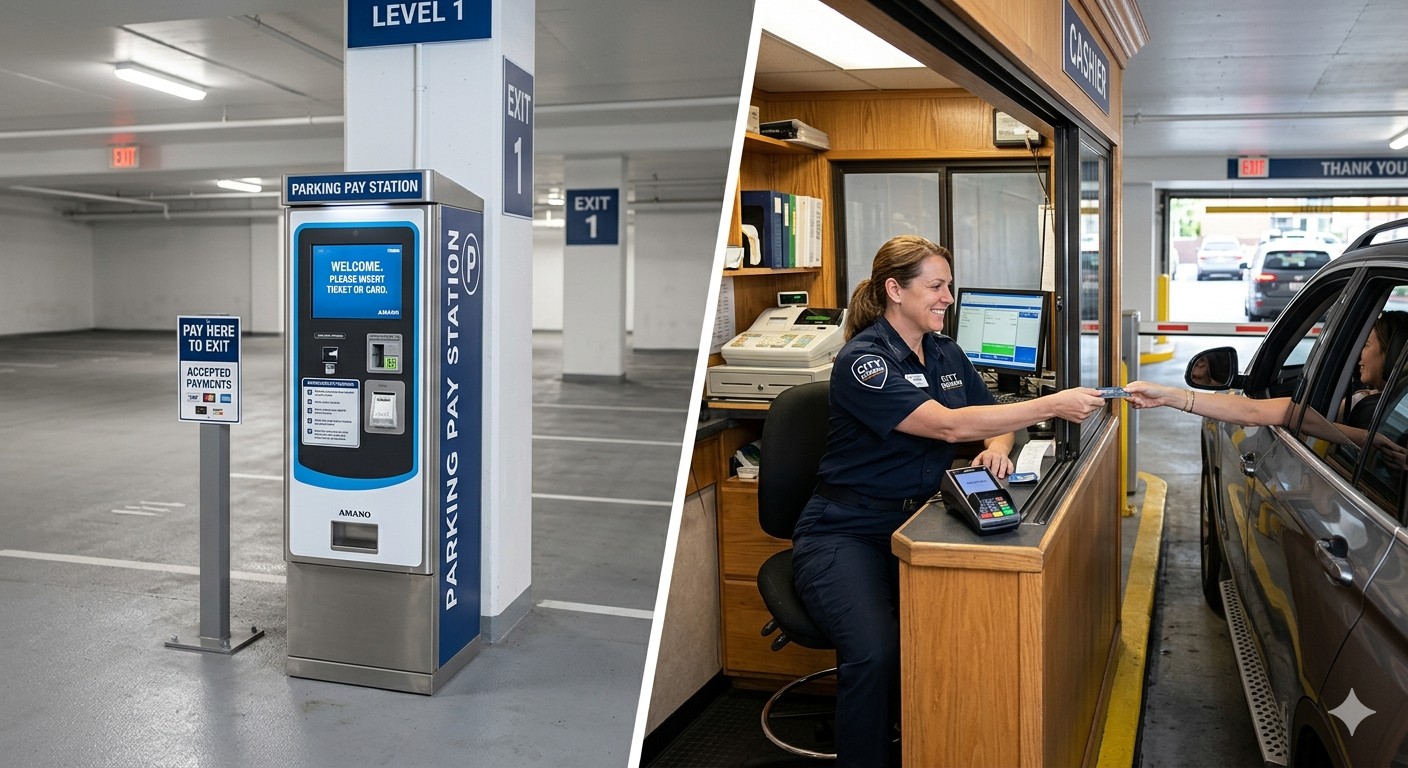
Every parking facility sits somewhere on a spectrum between fully staffed booths and fully automated self-service. Neither extreme is universally correct. A downtown hospital with elderly visitors and complex validation programs has different needs than a commuter garage where the same 400 monthly parkers come and go with barely a glance at the exit lane.
This article breaks down the operational, financial, and customer-experience trade-offs between automated and attended payment models so you can make a clear-eyed decision — or, more likely, land on the hybrid approach that most operators end up choosing.
Defining the Models
Fully Attended
A cashier or attendant sits in a booth at each exit lane (and sometimes at entry). They accept payment, make change, process validations, handle exceptions, and serve as the face of the operation. This was the standard for decades and remains common at valet operations, airports, and hospitals.
Fully Automated
Automated payment systems handle the entire transaction without human intervention. Parkers pay at a self-service station — either a pay-on-foot device inside the facility or a pay-in-lane terminal at the exit — and the gate lifts automatically. Exceptions are routed to a remote customer-service center via intercom and camera. Manufacturers like Scheidt & Bachmann, Skidata, Flowbird, and Hectronic all offer fully automated PARCS suites designed for unattended operation.
Hybrid
Most real-world facilities blend the two. Common hybrid configurations include:
- Automated lanes for credit-card and mobile payments, plus one attended lane for cash and exceptions.
- Unattended during off-peak hours, staffed during events or high-volume periods.
- Pay-on-foot stations inside the garage with a roaming attendant who assists but does not sit in a booth.
Side-by-Side Comparison
| Dimension | Fully Attended | Fully Automated | Hybrid |
|---|---|---|---|
| Labor cost | High | Minimal | Moderate |
| Throughput per lane | 3 – 5 vehicles / min | 6 – 10 vehicles / min | Varies by lane type |
| Cash handling | Easy | Requires bill/coin hardware | One lane handles cash |
| Exception handling | Immediate, personal | Remote via intercom | Mixed |
| Customer satisfaction (general) | High for complex needs | High for speed-oriented parkers | Balanced |
| Capital expenditure | Lower (simpler hardware) | Higher (self-service units) | Moderate |
| Scalability | Linear with headcount | Incremental with hardware | Flexible |
| Operating hours flexibility | Shift-dependent | 24 / 7 by default | 24 / 7 with staffed peaks |
The Financial Case
Labor Is the Dominant Cost
For a facility that operates 16 hours a day, seven days a week, a single attended exit lane costs roughly $45,000 to $65,000 per year in wages, benefits, and payroll overhead — more in high-cost metro areas. A two-lane garage with full-time attendants can easily spend $120,000+ annually on booth staff alone.
An automated pay-on-foot station, by contrast, carries a one-time hardware cost of $20,000 to $45,000 plus annual maintenance of $2,000 to $5,000 and software licensing of $2,000 to $8,000 per year. The payback period on automation is typically 18 to 36 months depending on local labor rates.
Cash Handling Adds Up
Attended operations that accept cash incur:
- Armored car service for daily or weekly pickups
- Cash-room labor for counting and reconciliation
- Counterfeit and theft losses (industry benchmarks suggest 1 – 3 % shrinkage)
- Bank deposit fees
Automated systems that accept cash shift these costs to the machine’s bill acceptor and coin hopper, which require periodic replenishment and jam clearing. Cashless automated systems eliminate the category entirely.
Revenue Leakage
Attended booths are vulnerable to revenue leakage through under-ringing, coupon fraud, and “friendly” discounting. Automated systems apply rate tables consistently. Operators who have switched from attended to automated commonly report a 5 – 15 % increase in collected revenue per transaction once human discretion is removed from the equation.
Throughput and Traffic Flow
Automated lanes process vehicles faster because the transaction is either pre-completed (pay-on-foot) or reduced to a single tap (contactless card at the exit terminal). The International Parking & Mobility Institute recommends designing exit capacity for peak fifteen-minute demand, and automated lanes consistently outperform attended lanes on that metric.
However, a single exception — a lost ticket, a malfunctioning card, a confused first-time visitor — can stall an automated lane just as effectively as a slow cashier stalls an attended one. The difference is that attended operations resolve the exception in the lane, while automated operations rely on an intercom call to a remote agent or a roaming attendant.
Throughput Planning Table
| Scenario | Attended Lane | Automated Lane (pay-in-lane) | Automated (pay-on-foot + barrier) |
|---|---|---|---|
| Average transaction time | 12 – 18 sec | 6 – 10 sec | 3 – 5 sec (validation only) |
| Vehicles per hour (sustained) | 180 – 250 | 300 – 450 | 500 – 700 |
| Exception rate | 2 – 5 % | 5 – 10 % | 2 – 4 % |
| Exception resolution time | 30 – 60 sec (in lane) | 60 – 120 sec (remote) | 30 – 60 sec (remote or roaming) |
Pay-on-foot models win on throughput because the barrier only needs to verify a pre-paid ticket or LPR match, which takes seconds. For a deeper look at how these architectures connect, see How Parking Payment Systems Work.
Customer Experience
When Attendants Win
Attendants excel at high-touch situations:
- Hospitals and medical centers where visitors may be stressed, elderly, or unfamiliar with the facility.
- Luxury hotels and Class-A office buildings where a personal greeting reinforces the brand.
- Event venues where thousands of infrequent visitors exit within a narrow window and exception volume spikes.
- Facilities with complex validation programs that confuse self-service users (e.g., multiple retailers with different discount tiers).
When Automation Wins
Automated systems deliver a better experience when:
- Speed is the priority. Commuters and daily parkers want to tap and go. A 12-second attended transaction feels slow to someone who parks in the same garage 250 days a year.
- Privacy matters. Some parkers prefer not to interact with a person, particularly at late hours.
- Consistency is valued. Automated systems charge the published rate every time, with no ambiguity.
- Mobile-first demographics dominate. Urban, tech-forward populations expect app-based payment as a baseline.
The Friction Factor
Parking consultant research consistently finds that payment friction — the time and effort a parker spends completing a transaction — is the single strongest predictor of satisfaction with the payment process. Reducing friction almost always improves net promoter scores, regardless of whether the reduction comes from a faster attendant or a smoother kiosk interface.
For strategies to cut friction across both models, see Reducing Payment Friction in Parking Operations.
Staffing Realities
The Labor Market Problem
Parking booth attendants are chronically difficult to recruit and retain. The work is repetitive, often solitary, and the shifts are unforgiving (nights, weekends, holidays). Turnover rates above 50 % per year are common in the industry, and each replacement cycle costs $3,000 to $5,000 in recruiting, training, and lost productivity.
Automation does not eliminate the need for people — it changes the roles. Operators who automate typically redeploy staff into:
- Roaming customer ambassadors who help parkers at kiosks, patrol for safety, and handle exceptions face-to-face.
- Remote monitoring agents who oversee multiple facilities from a central operations center via camera and intercom.
- Maintenance technicians who keep hardware running and perform cash replenishment.
Staffing Comparison
| Role | Attended Model | Automated Model |
|---|---|---|
| Booth cashiers | 2 – 4 per shift | 0 |
| Roaming attendants | 0 – 1 | 1 – 2 |
| Remote monitoring agents | 0 | 0.25 – 0.5 FTE per facility |
| Maintenance technicians | 0.5 FTE | 0.5 – 1 FTE |
| Supervisors / managers | 1 | 1 |
| Total FTEs (typical garage) | 5 – 8 | 2 – 4 |
Technology Requirements
Fully automated operations demand more from the technology stack:
- Reliable network connectivity. If the system goes offline and cannot process payments, vehicles stack up with no human fallback. Redundant internet connections (fiber + cellular failover) are strongly recommended.
- Remote monitoring platform. Cameras, intercoms, and real-time dashboards must be accessible 24/7 from a central location.
- Robust exception workflow. The system needs to route lost-ticket, disputed-charge, and hardware-fault scenarios to a remote agent quickly and with full context (entry photo, transaction history, live video).
- UPS and power redundancy. Automated lanes that lose power become impassable. Battery backup for gates and payment terminals is essential.
Attended operations are more forgiving of infrastructure gaps because the cashier can improvise (manually raise a gate, write a receipt by hand, call a supervisor on a cell phone).
Decision Framework
Use the following questions to determine where your facility falls on the spectrum:
- What is your annual labor budget for parking operations? If it exceeds $100,000, automation almost certainly delivers a positive ROI within three years.
- What is your peak exit volume? If you regularly exceed 300 vehicles per hour across all exit lanes, automated throughput gains are material.
- What percentage of transactions are cash? If cash exceeds 30 %, you either need cash-accepting kiosks (more expensive) or a transition plan to reduce cash usage.
- How complex are your validation programs? Simple flat-rate validations automate easily. Multi-tier, retailer-specific programs may need an attendant or a very well-designed kiosk UI.
- What is your customer demographic? Age, tech comfort, and visit frequency all influence acceptance of self-service.
- How reliable is your facility’s power and network infrastructure? Poor infrastructure raises the risk profile of full automation.
Making the Transition
Operators moving from attended to automated rarely flip a switch overnight. A phased approach reduces risk:
- Phase 1 — Add pay-on-foot stations while keeping attended lanes. This lets parkers self-select and gives staff time to adjust.
- Phase 2 — Convert one exit lane to automated. Monitor exception rates and customer feedback for 60 to 90 days.
- Phase 3 — Reduce attended lanes to one. Redeploy staff to roaming and remote-monitoring roles.
- Phase 4 — Go fully automated if exception rates are manageable and customer satisfaction holds steady.
Each phase should include clear KPIs: average transaction time, exception rate, revenue per transaction, and customer complaints per thousand exits.
The Vendor Landscape
Most major PARCS manufacturers — Flowbird, Hectronic, Skidata, Scheidt & Bachmann, IPS Group, and T2 Systems — offer equipment that supports both attended and automated configurations. The differentiator is usually the software: how well the remote-monitoring dashboard works, how flexible the rate engine is, and how seamlessly the system handles exceptions without on-site staff.
When evaluating vendors, ask for reference sites that operate in the same model you are targeting. A vendor with a thousand attended installations is not necessarily proven in unattended environments, and vice versa.
The Buyer’s Guide Connection
If you are in the early stages of evaluating payment systems, start with the complete buyer’s guide for a broader look at system categories, total cost of ownership, and procurement frameworks. This article narrows the lens to the specific attended-versus-automated question, but both guides are designed to work together.
Bottom Line
- Fully attended is justified for high-touch environments (hospitals, luxury properties) and facilities with complex validations and high cash usage.
- Fully automated delivers the strongest financial returns and fastest throughput for commuter garages, airports, and modern mixed-use developments.
- Hybrid is the pragmatic choice for most operators — automate the routine, staff the exceptions.
- The labor savings from automation are real, but they require investment in reliable infrastructure, remote-monitoring capability, and a well-designed exception workflow.
- Transition gradually, measure rigorously, and let the data — not vendor promises — guide each phase.