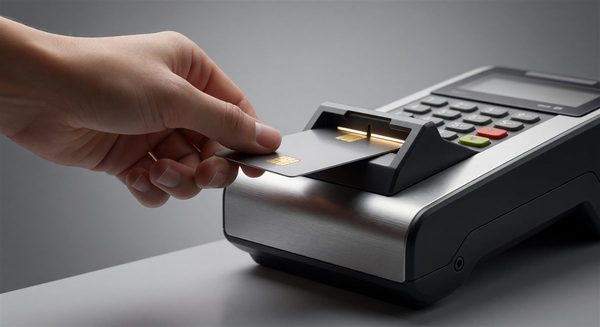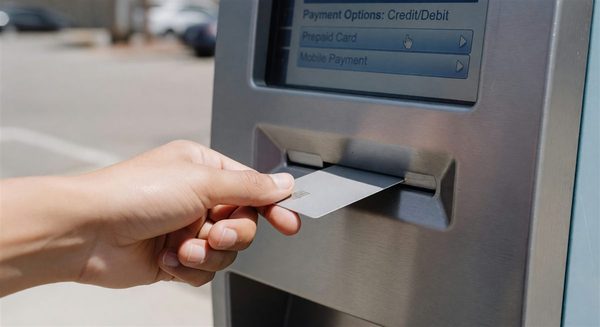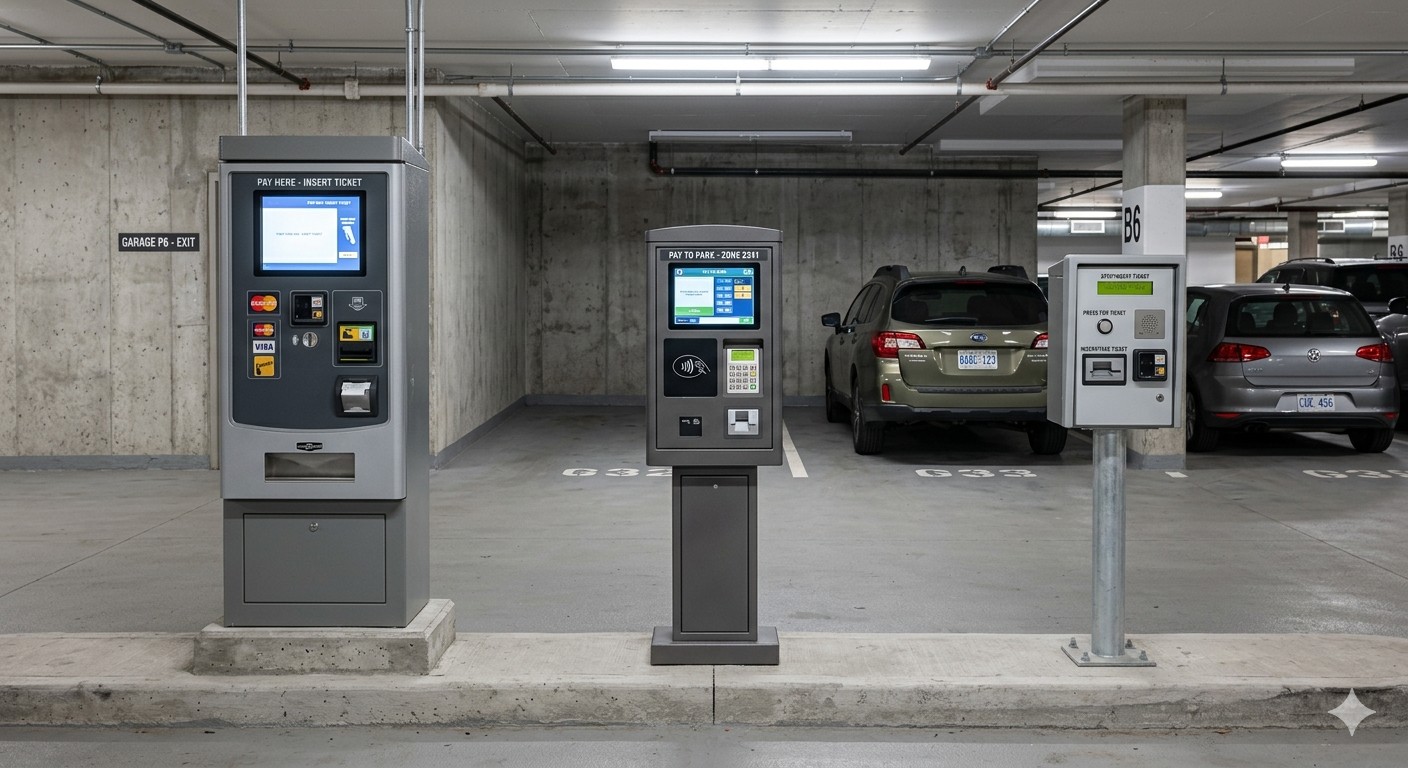
Walk through any modern parking facility and you will encounter at least one type of self-service payment device. The labels used for these machines vary wildly across the industry — manufacturers call them pay stations, operators call them kiosks, and legacy signage still reads “ticket machine.” While the terms overlap, the hardware behind each label serves a distinct purpose, and choosing the wrong category can cost an operator tens of thousands of dollars in mismatched functionality.
This guide breaks down what separates a parking pay station from a general-purpose kiosk and a traditional ticket machine, helping you match the right hardware to your operation.
What Is a Parking Pay Station?
A parking pay station is a purpose-built outdoor device designed specifically for collecting parking fees. Unlike generic retail kiosks, pay stations are engineered from the ground up for unattended, all-weather operation in parking environments. They accept multiple payment types — coins, bills, credit and debit cards, and increasingly contactless and mobile payments — and integrate directly with access-control equipment like barrier gates and loop detectors.
Core Characteristics of Pay Stations
- Weather-hardened enclosures rated for outdoor temperature extremes, rain, snow, and direct sunlight
- EMV-certified card readers meeting current PCI DSS requirements for unattended payment terminals
- Multi-payment acceptance including coin, bill, credit/debit, contactless tap, and QR code options
- Direct integration with barrier arms, loop detectors, and parking management software
- Remote management via cellular or network connections for real-time monitoring and configuration changes
Major manufacturers in this space include Flowbird (formerly Parkeon), Hectronic, Scheidt & Bachmann, IPS Group, and T2 Systems. Each takes a slightly different approach to enclosure design, payment processing, and software architecture, but all share the defining trait of being purpose-built for parking revenue collection.
What Is a Self-Service Kiosk?
The term “kiosk” is far broader. A self-service kiosk is any interactive terminal where a user completes a transaction or retrieves information without staff assistance. Kiosks appear in airports, fast-food restaurants, hotel lobbies, government offices, and retail stores. In parking, the word kiosk sometimes refers to a pay station, but it can also mean a wayfinding terminal, a validation station, or a general-purpose touchscreen that happens to sit in a parking garage.
How Kiosks Differ from Dedicated Pay Stations
| Feature | Parking Pay Station | General-Purpose Kiosk |
|---|---|---|
| Primary function | Collect parking fees | Varies (info, check-in, ordering, payment) |
| Enclosure rating | NEMA 3R/4 or IP55+ outdoor | Often indoor-only (NEMA 1/IP20) |
| Payment hardware | EMV chip, contactless, coin, bill | May have card reader only, or none |
| Gate integration | Native — opens barriers on payment | Requires custom middleware |
| Operating temperature | -30 C to +50 C typical | Climate-controlled environments |
| Cash handling | Bill validators, coin acceptors, change dispensers | Rarely includes cash hardware |
| Regulatory compliance | PCI PTS for unattended terminals | PCI requirements vary by application |
The key distinction is specialization. A parking pay station arrives pre-configured with the payment peripherals, communication protocols, and software hooks that parking demands. A general kiosk can theoretically be adapted for parking use, but the integration burden — and the ongoing maintenance complexity — falls on the operator or a systems integrator.
What Is a Ticket Machine?
Ticket machines (also called ticket dispensers or ticket spitters) are the oldest category. Their job is simple: issue a ticket that records a vehicle’s entry time. The ticket itself is the transaction token — the driver takes it, parks, and later presents it at a separate pay station or staffed cashier booth for payment calculation.
Ticket Machines in the Modern Landscape
Traditional ticket machines do not process payments. They dispense a paper ticket (often with a magnetic stripe or barcode) and signal a barrier gate to open. Payment happens elsewhere. This two-device model — ticket dispenser at entry, pay station at exit or in a pedestrian area — defined parking infrastructure for decades and is still common in older garages.
However, the trend is clearly moving toward consolidated devices and ticketless systems. Many newer facilities skip the ticket machine entirely, using license plate recognition cameras or mobile app check-ins to track entry. Where ticket machines persist, they increasingly incorporate basic payment functions, blurring the line with pay stations.
Side-by-Side Comparison
| Criteria | Pay Station | Kiosk | Ticket Machine |
|---|---|---|---|
| Accepts payments | Yes — multi-tender | Sometimes | Rarely |
| Issues tickets | Some models | No | Yes — primary function |
| Outdoor rated | Yes | Usually no | Yes |
| Integrates with gates | Native | Custom | Native |
| Touchscreen UI | Standard | Standard | Rare (button-based) |
| Remote management | Yes | Varies | Basic or none |
| Typical cost range | $8,000 - $35,000+ | $3,000 - $15,000 | $4,000 - $12,000 |
| Common locations | Garages, surface lots, on-street | Lobbies, pedestrian areas | Garage entry lanes |
When Each Device Makes Sense
Choose a Pay Station When:
- You need unattended payment collection — surface lots, garages without cashier booths, on-street parking
- Multiple payment methods are required — credit card, cash, contactless, and mobile wallet acceptance
- Integration with access control is essential — barrier gates, loop detectors, PARCS systems
- The device will be exposed to weather — outdoor installations with no climate-controlled housing
- Remote monitoring matters — you want real-time alerts for jams, low receipt paper, or payment failures
For a deeper look at what separates a good pay station from a great one, see our guide on what to look for in parking payment machines.
Choose a General Kiosk When:
- The terminal is indoors — a lobby or elevator vestibule in a controlled environment
- You need multi-function capability — validation, wayfinding, payment, and information on one screen
- The kiosk supplements rather than replaces a PARCS-integrated pay station
- Custom branding or user experience is a higher priority than ruggedized hardware
Choose a Ticket Machine When:
- Your facility uses a ticket-based PARCS and you need entry-lane ticket dispensing
- You already have separate pay stations for fee collection and want a lower-cost entry device
- Legacy infrastructure does not support ticketless alternatives like LPR or mobile apps
Key Features to Evaluate Across All Three
Regardless of which device category fits your operation, several features deserve scrutiny during procurement.
Payment Security and Compliance
Every device that touches a credit or debit card must comply with PCI DSS. For unattended parking terminals specifically, look for PCI PTS certification on the pin pad and card reader module. EMV chip and contactless (NFC) acceptance are no longer optional — they are baseline requirements in 2026. The International Parking & Mobility Institute has published guidance on payment security standards for parking operators that is worth reviewing.
Connectivity and Remote Management
Modern pay stations connect via cellular (4G/5G), Ethernet, or Wi-Fi and report status to a cloud dashboard. This lets operators see transaction volumes, error codes, and maintenance alerts without sending a technician. If you are evaluating a device that lacks remote management, treat that as a serious red flag — the labor cost of manual monitoring will dwarf any hardware savings.
Environmental Ratings
Outdoor devices should carry a NEMA 3R or NEMA 4 enclosure rating (or the equivalent IP55/IP65 in international standards). This covers rain, sleet, dust, and hose-directed water. Indoor kiosks need not meet these standards, but if there is any chance the device will be installed in a semi-outdoor environment — a parking garage with open walls, for example — err on the side of a hardened enclosure.
Maintenance and Serviceability
Look for tool-free access to high-wear components: receipt printers, card readers, bill validators, and coin hoppers. The best pay stations use modular drawer systems that let a technician swap a jammed printer in under five minutes. Ask the manufacturer about mean time between failures (MTBF) for each component and whether replacement parts are stocked domestically.
Software and Integration
The hardware is only half the equation. The management software determines how easily you can adjust rates, pull reports, and push firmware updates. Some manufacturers offer cloud-based management platforms, while others rely on on-premise servers. Neither approach is inherently better, but make sure the software roadmap aligns with your operational goals.
The Convergence Trend
The boundaries between these three device categories are eroding. Today’s high-end pay stations include touchscreens, validation scanners, and wayfinding features that once defined kiosks. Meanwhile, ticket machines are disappearing as ticketless technologies — LPR cameras, Bluetooth beacons, and mobile apps — eliminate the need for a physical entry token.
For operators planning a new installation or a technology refresh, the practical question is no longer “which device category?” but rather “what functions do I need at each lane position?” The answer usually points toward a modern, multi-payment pay station at the core, supplemented by mobile and LPR options that reduce dependence on any single piece of hardware.
For a comprehensive view of all the hardware and software components in a modern parking payment ecosystem, our complete buyer’s guide covers the full picture.
Cost Considerations
Budget planning requires looking beyond the purchase price. A pay station costing $20,000 with built-in EMV, cellular connectivity, and a five-year parts warranty may deliver lower total cost of ownership than a $6,000 ticket machine paired with a $10,000 third-party payment terminal and custom integration labor.
Typical Cost Breakdown
| Cost Component | Pay Station | Kiosk | Ticket Machine |
|---|---|---|---|
| Hardware purchase | $8,000 - $35,000 | $3,000 - $15,000 | $4,000 - $12,000 |
| Installation | $1,500 - $5,000 | $500 - $2,000 | $1,500 - $4,000 |
| Annual maintenance | $800 - $2,500 | $400 - $1,200 | $600 - $1,500 |
| Payment processing fees | 2.5% - 3.5% per txn | Varies | N/A (no payment) |
| Software subscription | $50 - $300/mo | $30 - $150/mo | $0 - $50/mo |
The National Parking Association publishes annual benchmarking data that can help operators compare these costs against industry averages for their facility type and region.
Key Takeaways
- Pay stations are purpose-built for parking revenue collection — they handle multiple payment types, integrate with gates, and survive outdoor conditions. They are the workhorse of modern parking infrastructure.
- Kiosks are general-purpose interactive terminals. They work well indoors for supplementary functions but require significant customization to replace a dedicated pay station.
- Ticket machines dispense entry tickets but do not process payments. They are a legacy technology that is steadily being replaced by ticketless alternatives.
- Evaluate total cost of ownership, not just purchase price — installation, maintenance, processing fees, and software subscriptions all factor in.
- The industry is converging toward multi-function pay stations and ticketless entry, making the traditional three-category distinction less relevant with each passing year.