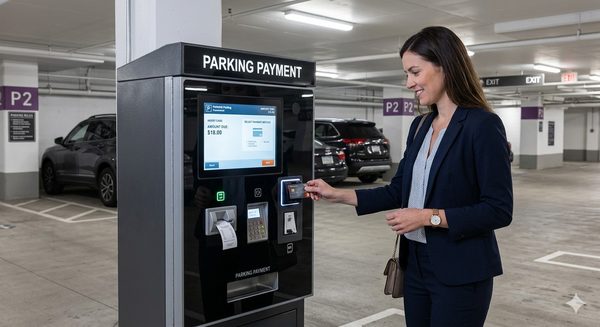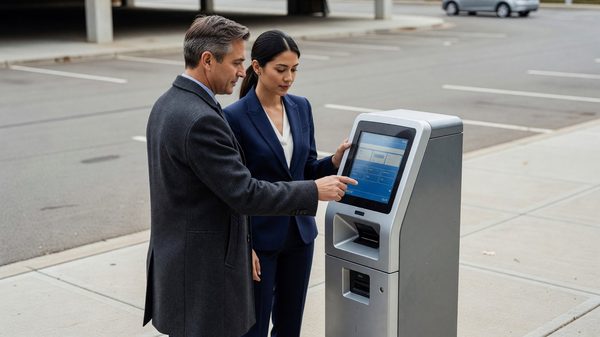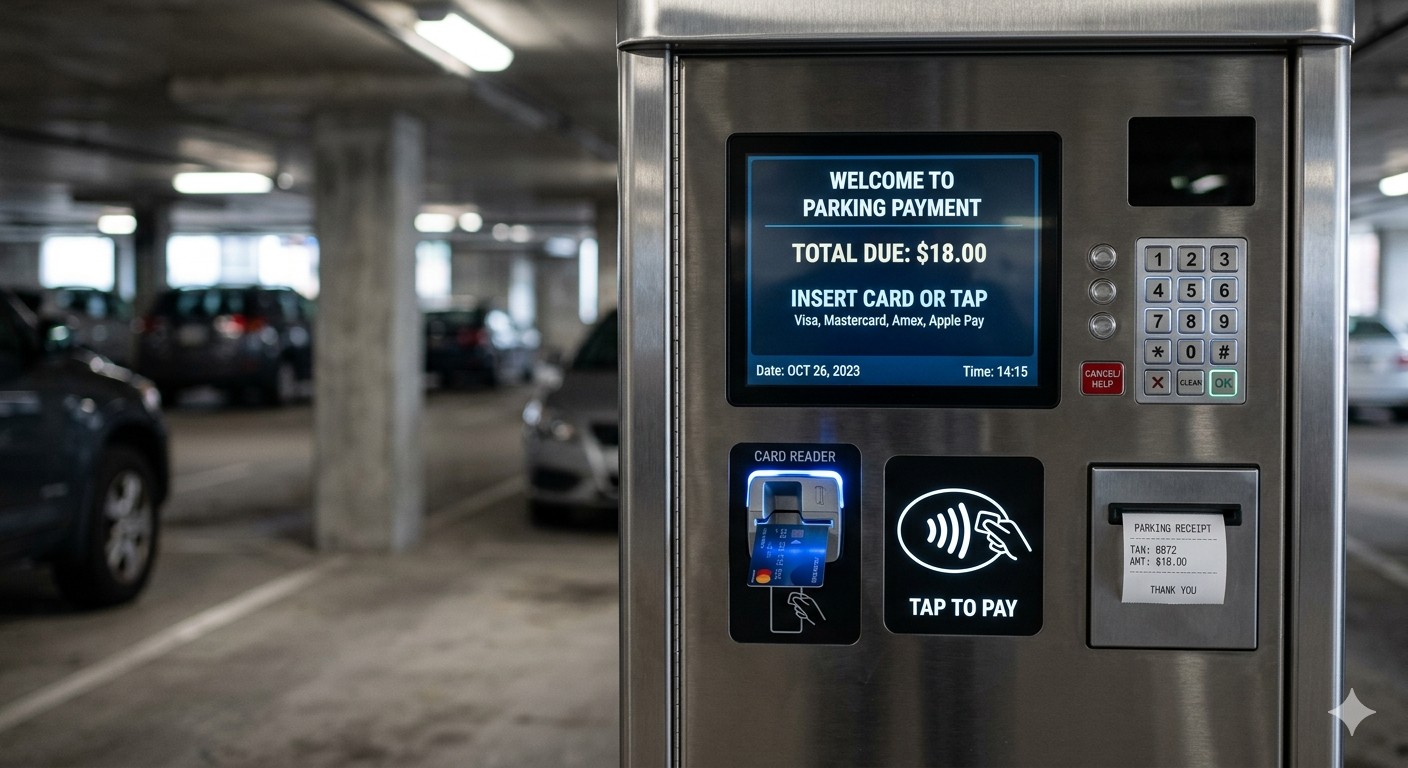
A parking payment machine is the piece of equipment your customers actually touch. It handles money, withstands weather, operates around the clock, and shapes the parker’s perception of your facility. Yet procurement decisions often focus disproportionately on the back-end software and breeze past the hardware specifications that determine whether the machine will still be functioning reliably in year eight of a ten-year deployment.
This guide focuses on the physical machine itself — what to inspect, what to specify, and what separates a pay station that earns its keep from one that becomes a maintenance liability.
Types of Parking Payment Machines
Before evaluating specifications, clarify which type of machine fits your operational model.
Pay-on-Foot Stations
Located inside the facility (lobbies, stairwells, elevator banks), these machines handle the full transaction before the parker returns to their vehicle. They are the workhorse of modern garage operations and offer the best throughput because the exit lane only needs to verify that payment is complete.
Pay-in-Lane Terminals
Mounted at the exit lane, these machines process payment as the driver waits in the vehicle. They are smaller and simpler than pay-on-foot units but create exit-lane bottlenecks when transactions are slow or exceptions arise.
Multi-Space Meters
Designed for surface lots, multi-space meters serve multiple stalls from a single unit. Parkers walk to the meter, enter their stall number or receive a receipt to display on the dashboard. These are a different product category from garage pay stations, though some manufacturers (Flowbird, Hectronic, IPS Group) offer both under a unified management platform.
For a detailed comparison of how these categories differ in architecture and use case, see Pay Station vs. Kiosk vs. Ticket Machine.
Payment Acceptance: The Non-Negotiables
EMV Chip and Contactless
Every payment machine purchased in 2026 must support EMV chip cards and contactless (NFC) payments. The liability shift for counterfeit fraud at unattended terminals has been in effect since 2021 in the United States, meaning operators with magstripe-only readers bear the cost of fraudulent transactions. EMVCo’s specifications define the certification requirements for unattended payment devices.
Key specifications to confirm:
| Specification | Minimum Requirement |
|---|---|
| EMV Level 1 (hardware) | Certified to current EMVCo spec |
| EMV Level 2 (software) | Kernel certified for Visa, Mastercard, Amex, Discover |
| Contactless range | ISO 14443 A/B, NFC Forum compliant |
| PIN pad | Encrypted, PCI PTS certified (current version) |
| Point-to-point encryption | P2PE or validated E2EE solution |
Cash Acceptance (If Applicable)
Not every facility needs cash-accepting machines, and going cashless reduces maintenance, shrinkage, and armored-car costs. However, facilities in areas with cash-access laws (New York City, Philadelphia, San Francisco, New Jersey, and Massachusetts all have varying requirements) or those serving demographics with lower card adoption may need to accept cash.
Cash-handling components to evaluate:
- Bill acceptor: Look for models that accept all current US denominations ($1 through $100) and recycler units that can dispense bills as change.
- Coin acceptor and hopper: Verify the coin capacity and whether the hopper can be removed for easy servicing.
- Counterfeit detection: UV, magnetic, and optical sensors for bill validation.
- Cash cassette capacity: Larger cassettes mean fewer collection trips. A high-volume garage may need 1,000+ bill capacity.
Mobile and QR Payments
Increasingly, pay stations include a barcode scanner or QR reader that lets parkers pay via a mobile app. The machine scans the app-generated code and confirms payment. This shifts the transaction to the parker’s phone, which reduces wear on the machine’s card reader and speeds throughput.
Physical Durability
Payment machines live in harsh environments — exposed to temperature extremes, humidity, dust, vandalism, and continuous mechanical use. Durability is not a soft requirement; it directly drives maintenance cost and uptime.
Enclosure Construction
| Feature | What to Look For |
|---|---|
| Material | 14-gauge or heavier stainless steel or powder-coated steel |
| Lock type | High-security tubular or electronic locks (not standard keyed) |
| Vandal resistance | Anti-pry bezels, tamper-evident seals, reinforced card slot |
| Weather rating | NEMA 3R minimum for semi-exposed locations; NEMA 4 for outdoor |
| Operating temperature | -30 C to +50 C for most North American climates |
| Humidity tolerance | 5 % to 95 % non-condensing |
Screen Technology
Touchscreens are the primary user interface. Specify:
- Display type: High-brightness LCD or LED, minimum 1,000 nits for outdoor or semi-exposed locations where direct sunlight is a factor.
- Touch technology: Projected capacitive (PCAP) screens work with gloved fingers and tolerate moisture better than resistive screens.
- Screen size: 10 to 15 inches is standard. Larger screens improve usability for ADA compliance.
- Anti-glare and anti-vandal overlay: Tempered glass with anti-reflective coating.
Mechanical Components
The components that move and wear are the ones that fail:
- Card reader: Motorized dip readers are more common in pay stations than swipe readers. Specify a reader rated for 500,000+ insertion cycles.
- Receipt printer: Thermal printers dominate because they have no ink cartridges to replace. Look for auto-cutter mechanisms rated for 1 million+ cuts and easy paper-roll replacement.
- Bill acceptor: Ask for the jam-clear procedure. A bill acceptor that requires a technician to disassemble the unit for a paper jam is a maintenance nightmare.
- Barrier gate arm motor: If evaluating an integrated pay-in-lane terminal with gate, confirm the motor’s rated cycle count (1 million minimum for moderate-volume facilities).
Accessibility and ADA Compliance
Payment machines must comply with the Americans with Disabilities Act (ADA) and local accessibility codes. Non-compliance exposes the operator to legal liability and excludes a segment of parkers from self-service.
ADA Requirements for Pay Stations
- Reach range: Operable controls must be between 15 and 48 inches from the floor for a forward approach, or between 15 and 54 inches for a side approach.
- Clear floor space: A 30-by-48-inch clear space must be available in front of the machine for wheelchair access.
- Card reader and screen: Both must fall within reach range. Some manufacturers offer adjustable-height units or dual-height configurations.
- Audio guidance: An audio jack or speaker with step-by-step voice instructions for visually impaired users.
- Braille and tactile labels: Required on physical buttons and control surfaces.
- High-contrast display: Text and UI elements must meet WCAG contrast ratios.
European operators should additionally verify compliance with EN 301 549 (ICT accessibility) and any applicable national standards.
Connectivity and Integration
A payment machine is only as useful as its connections to the broader system.
Network Options
| Connection Type | Pros | Cons |
|---|---|---|
| Wired Ethernet | Most reliable, lowest latency | Requires cabling to each unit |
| Wi-Fi | Flexible placement | Interference in concrete garages |
| Cellular (4G/5G) | No facility network needed | Recurring data cost, latency |
Most pay-on-foot installations use wired Ethernet for reliability. Cellular is common for surface-lot multi-space meters where running cable is impractical.
Integration Points
Confirm that the machine supports:
- LPR matching — Can the machine look up a parking session by license plate in addition to (or instead of) ticket barcode?
- Validation systems — Can it accept QR codes, barcodes, or NFC tags from retail validation programs?
- Mobile payment APIs — Does it expose an API that allows third-party mobile apps to initiate and confirm transactions?
- Central management platform — Does it communicate with the vendor’s cloud dashboard for rate changes, diagnostics, and reporting?
For the full architecture behind these connections, see How Parking Payment Systems Work for the payment-specific layer and the broader architecture guide for system-level context.
Maintenance and Serviceability
The easiest specification to overlook and the most expensive to get wrong. A machine that is difficult to service costs more in technician time, longer downtime, and frustrated parkers.
Serviceability Checklist
- Front-access design. Can the technician service all components — card reader, printer, cash module, network board — from the front of the machine, without pulling it away from the wall?
- Modular components. Are the card reader, printer, and bill acceptor swappable modules, or are they hardwired into the chassis? Modular design means a technician can swap a failed reader in five minutes instead of troubleshooting in the field for an hour.
- Diagnostic display. Does the machine have a technician-facing diagnostic screen or LED panel that shows error codes and component status without requiring a laptop connection?
- Remote diagnostics. Can the vendor or your maintenance team see the machine’s status — paper level, cash cassette fill, error codes, last transaction — from a remote dashboard?
- Parts availability. Ask the vendor for their parts-stocking policy. A 24-hour parts shipment commitment is standard for Tier 1 manufacturers. If the vendor tells you lead times exceed one week for common consumables, that is a red flag.
Preventive Maintenance Schedule
| Component | Typical Service Interval |
|---|---|
| Card reader cleaning | Monthly |
| Receipt paper replacement | As needed (remote alert) |
| Cash cassette collection | Weekly to monthly (volume-dependent) |
| Bill acceptor cleaning | Quarterly |
| Software / firmware updates | Per vendor release schedule |
| Full inspection (mechanical, electrical) | Semi-annually |
| Screen calibration and cleaning | Quarterly |
Budget 8 to 12 percent of the machine’s purchase price annually for maintenance, including parts and labor.
Vendor Evaluation
The Major Players
Several manufacturers compete in the North American and European pay-station market. Each has strengths:
- Flowbird — Strong in both on-street meters and off-street pay stations; large global installed base.
- Hectronic — German engineering with a focus on robustness and modular design.
- Scheidt & Bachmann — Enterprise-grade machines for airports, hospitals, and high-volume garages.
- Skidata — Widely deployed in resort, stadium, and mixed-use environments.
- T2 Systems — Software-first platform with compatible hardware for university and municipal markets.
Questions for the Vendor
- What is the mean time between failures (MTBF) for this machine model?
- How many units of this model are currently deployed, and for how long?
- Can I visit a reference site that operates in a similar climate and volume?
- What is the warranty period, and what does it cover (parts, labor, on-site)?
- How are firmware and EMV kernel updates delivered, and how often?
- What is the expected service life of this unit before major component replacement?
- If I switch management platforms in five years, can this hardware work with a different back-end?
Red Flags
- A vendor who cannot provide MTBF data or reference customers.
- Proprietary consumables (receipt paper, ticket stock) that cost two to three times the generic equivalent.
- No published maintenance manual or technician training program.
- EMV certification that is more than two years old without a recertification plan.
- A machine design that requires rear access for routine maintenance in a location where rear access is obstructed.
Specification Template
Use this table as a starting point for your RFP or specification document:
| Specification Category | Requirement |
|---|---|
| Payment methods | EMV chip, contactless, mobile QR, [cash optional] |
| EMV certification | Level 1 + Level 2, current spec |
| PCI compliance | PTS certified PIN pad, P2PE capable |
| Enclosure | Stainless or powder-coated steel, NEMA 3R+ |
| Operating temperature | -30 C to +50 C |
| Screen | 12"+ high-brightness PCAP touchscreen |
| Printer | Thermal, auto-cut, 1M+ cut cycle rating |
| ADA compliance | Reach range, audio guidance, Braille, high contrast |
| Connectivity | Ethernet standard, cellular optional |
| Remote diagnostics | Real-time status, error alerts, paper/cash level |
| Serviceability | Front-access, modular components |
| Warranty | Minimum 2 years parts and labor |
Key Takeaways
- The payment machine is the customer-facing face of your parking operation. Its durability, usability, and reliability directly affect revenue and satisfaction.
- EMV chip, contactless, and P2PE encryption are mandatory specifications in 2026. Do not accept anything less.
- Prioritize serviceability: front-access design, modular components, remote diagnostics, and fast parts availability.
- ADA compliance is a legal requirement and a usability advantage. Verify reach range, audio guidance, and contrast ratios.
- Evaluate machines in person, ideally at a reference site in a climate similar to yours. A showroom demo does not replicate eight Minnesota winters.
- The PCI Security Standards Council maintains the current list of validated payment terminals and P2PE solutions — cross-reference the vendor’s claims against this list.
The right payment machine is the one that still works well in year eight, not just the one that looks best on day one. Specify for longevity, test for serviceability, and hold the vendor to documented performance standards.