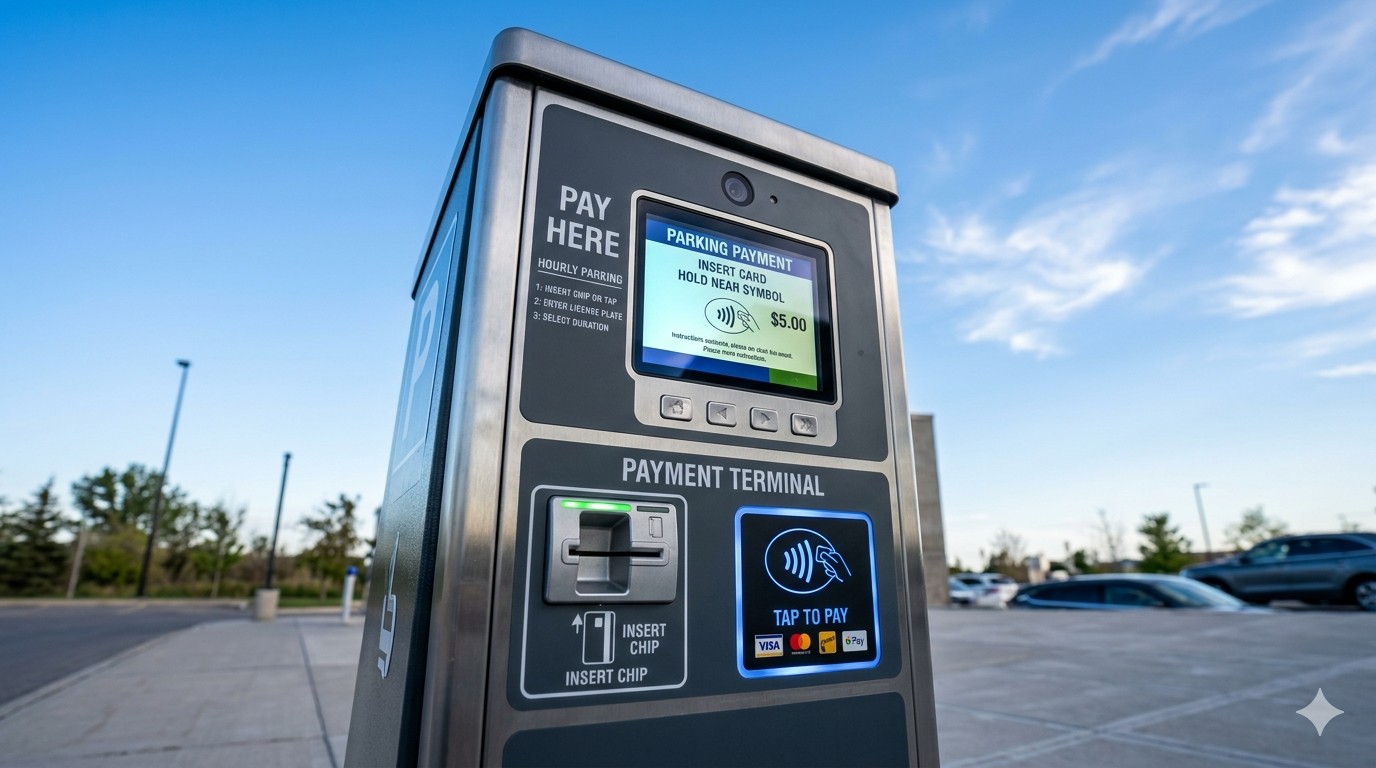
PCI DSS 4.0 for Parking Pay Stations: A Compliance Guide
Every parking pay station that accepts a credit or debit card is a point of cardholder data entry — and therefore subject to the Payment Card Industry Data Security Standard (PCI DSS). Version 4.0, which became the sole enforceable version on March 31, 2024, introduced meaningful changes for unattended payment environments. Understanding how the standard applies specifically to a parking pay station helps operators, facility managers, and technology administrators build a defensible compliance program and avoid the costly consequences of a breach or failed audit.
This guide walks through the key requirements of PCI DSS 4.0 as they relate to parking payment systems, from merchant classification and self-assessment questionnaires to network segmentation, penetration testing, and the common gaps auditors find in the field.
What Changed in PCI DSS 4.0 vs 3.2.1
PCI DSS 4.0 was finalized by the PCI Security Standards Council in March 2022 and replaced version 3.2.1 entirely on March 31, 2024. The headline changes relevant to parking operations include:
Customized implementation. For the first time, organizations can satisfy a requirement through a method that differs from the defined approach, provided they can demonstrate the stated security objective is still achieved. This gives operators more flexibility but demands stronger documentation.
Expanded multi-factor authentication (MFA) scope. MFA is now required for all access into the cardholder data environment (CDE), not just remote access. Any administrator or IT technician logging into a back-office server that touches payment data must use MFA.
Targeted risk analysis. Many requirements that previously had fixed frequencies (e.g., quarterly password changes) now allow operators to conduct a targeted risk analysis and set their own frequency — provided the analysis is documented and reviewed annually.
Stronger authentication requirements. Passwords for service accounts and system components must be at least 12 characters (up from 8), and password change policies are tied to risk analysis outcomes.
E-commerce and phishing focus. While less directly applicable to hardware pay stations, Requirement 6.4.3 (script management) and Requirement 12.6.2 (phishing awareness) are now mandatory and affect any parking operator running a web-based payment portal alongside physical equipment.
The net effect for parking operators is more documentation burden but also more flexibility — especially valuable for operators managing a mix of legacy and modern equipment across multiple locations.
How PCI DSS Applies to Parking Pay Stations
A parking pay station processes cardholder data at the point of interaction. Depending on the system architecture, that data may be encrypted at the device, transmitted to a payment processor, and never stored on-premises — or it may pass through a local network before reaching the processor. The compliance scope depends entirely on where cardholder data flows and how it is protected.
Key definitions that govern scope:
- Cardholder Data Environment (CDE): Any system component that stores, processes, or transmits primary account number (PAN) data, plus any system that could impact the security of those components.
- Account Data: Includes the PAN, cardholder name, service code, expiration date, and sensitive authentication data (CVV, PIN, magnetic stripe full track data).
For a typical parking pay station deployment, the CDE includes the physical terminal, the local network segment it connects to, the payment gateway integration, and any back-office management console with access to transaction data. If the terminal uses a validated Point-to-Point Encryption (P2PE) solution, significant portions of the network can be scoped out of the CDE.
See the related guide to PCI compliance for parking payment systems for a broader overview of scope reduction strategies.
Merchant Levels and SAQ Types for Parking Operators
Parking operators are classified as merchants under the PCI DSS framework. Your merchant level determines the validation requirements you must meet each year.
| Level | Criteria | Validation Required |
|---|---|---|
| 1 | Over 6 million transactions/year across all card brands | Annual on-site QSA assessment + quarterly network scans |
| 2 | 1–6 million transactions/year | Annual SAQ or QSA assessment + quarterly scans |
| 3 | 20,000–1 million e-commerce transactions/year | Annual SAQ + quarterly scans |
| 4 | Fewer than 20,000 e-commerce or up to 1 million other transactions | Annual SAQ + quarterly scans (issuing bank may vary) |
Most parking operators — single-location facilities, municipal lots, small campus operators — fall into Level 4. Large national operators or those processing high transaction volumes may qualify as Level 2 or Level 1.
Self-Assessment Questionnaire (SAQ) selection is critical. The wrong SAQ type under-scopes compliance and creates audit exposure. For parking pay station environments, the most relevant SAQ types are:
- SAQ B: For operators using imprint-only terminals or standalone dial-up terminals with no electronic cardholder data storage. Rare in modern deployments.
- SAQ B-IP: For operators using IP-connected payment terminals that are PCI PTS-approved and do not store electronic cardholder data. The terminal must connect directly to the payment processor over a secure connection. Common for stand-alone pay station deployments.
- SAQ P2PE: For operators using a PCI-validated P2PE solution. This is the most favorable SAQ — only 35 questions, with no network scanning requirement when scope is properly documented.
- SAQ C: For operators with payment applications connected to the internet. Applies when the pay station software has internet-facing components beyond the direct processor connection.
- SAQ D (Merchant): The full SAQ — over 200 controls. Required when none of the above criteria are met, typically because cardholder data touches multiple system layers or is stored.
Consult your acquiring bank to confirm which SAQ applies to your specific deployment. Misclassification is one of the most common compliance errors in the parking industry.
P2PE and Why It Matters for Unattended Pay Stations
Point-to-Point Encryption (P2PE) is a PCI SSC-validated solution category that encrypts cardholder data at the moment of card interaction — before it enters any software layer — and decrypts it only within the payment processor’s secure environment. For parking pay stations, P2PE is one of the most effective tools for reducing compliance scope.
When a validated P2PE solution is in use:
- The PAN is never present in plaintext within the parking operator’s environment.
- The network segment carrying encrypted data is generally descoped from PCI DSS requirements.
- The operator qualifies for SAQ P2PE rather than the more demanding SAQ C or SAQ D.
- On-site network scanning and many firewall configuration requirements no longer apply to the descoped segment.
The PCI SSC maintains a validated P2PE solutions list on its website. Only solutions on this list qualify for scope reduction. Operators should verify that their payment terminal vendor uses a listed solution and obtain the P2PE Implementation Manual (PIM) required to document the deployment correctly.
For unattended pay stations in outdoor or low-supervision environments, P2PE also reduces the impact of physical tampering attacks. Even if a skimming device is attached to the terminal, only encrypted data is accessible.
EMV Certification and PCI PTS Requirements
Two separate but related standards govern the hardware security of a parking pay station:
EMV (Europay, Mastercard, Visa) defines the chip card transaction protocol. EMV-compliant terminals read the chip, perform cryptographic verification, and generate a transaction-specific authorization code that cannot be reused. This eliminates the counterfeit card fraud vector that plagued magnetic stripe systems. EMVCo manages the EMV specifications and the certification program for terminals.
PCI PTS (PIN Transaction Security) is the PCI SSC standard governing the physical and logical security of payment terminals, including pay stations. A PCI PTS-approved device has been tested to resist physical tampering, logical attacks on the secure element, and unauthorized access to cryptographic keys. Terminals must be on the PCI SSC’s list of approved PTS devices to qualify for scope reduction under SAQ B-IP.
Key practical notes for parking operators:
- PCI PTS approvals expire. Terminals with an expired PTS approval do not qualify for reduced-scope SAQs and may be flagged by auditors or acquiring banks.
- EMV certification and PCI PTS approval are separate certifications. A terminal can be EMV-certified without being PCI PTS-approved, and vice versa. Both are typically required for a compliant modern deployment.
- Contactless (NFC) payments at parking pay stations follow the same framework — see the guide to EMV contactless payments in parking for specifics on tap-to-pay compliance considerations.
Network Segmentation for Parking Payment Systems
Network segmentation isolates the cardholder data environment from the rest of the operator’s corporate or facility network. Without segmentation, every device on the broader network — cameras, access control systems, administrative workstations, IoT sensors — becomes part of the CDE and must be included in the compliance assessment.
Effective segmentation for a parking payment system typically involves:
Dedicated VLAN for payment terminals. Pay stations should sit on a separate VLAN that has no lateral connectivity to office networks, management systems, or public Wi-Fi. All inter-VLAN traffic should pass through a stateful firewall with rules that permit only the specific protocol and destination required for payment processing (typically outbound HTTPS or TLS to the payment gateway’s IP range).
Firewall rule review. PCI DSS Requirement 1.2.1 mandates that firewall and router rules be reviewed at least once every six months. Rules should be documented with a stated business justification for each allowed connection. Inbound traffic from the internet to payment terminals should be blocked by default.
Restricting remote access. Any remote access into the payment network segment — for maintenance, firmware updates, or troubleshooting — must use MFA and be logged. Jump servers or bastion hosts are the preferred architecture. Direct RDP or SSH from the public internet to payment terminals is a PCI DSS violation.
Segmentation testing. Requirement 11.4.5 in PCI DSS 4.0 requires that segmentation controls be tested at least once every six months and after any change to segmentation. This test must be performed by a qualified internal resource or a third party and must include an attempt to traverse the segmentation boundary from outside the CDE.
Quarterly Scans, Penetration Testing, and Evidence Requirements
Annual compliance is not a single event — it requires ongoing operational activity throughout the year.
Quarterly external vulnerability scans must be conducted by a PCI SSC-approved Authorized Scanning Vendor (ASV). The scan must cover all externally reachable IP addresses associated with the CDE. For parking operators, this typically includes any public IP used by a payment gateway API endpoint or remote access portal. All high-severity findings must be remediated before the scan passes.
Annual internal vulnerability scans are required after any significant network change and at least quarterly for Level 1 merchants. Internal scans can be performed by qualified internal staff.
Annual penetration testing is required for all merchants under PCI DSS 4.0 (Requirement 11.4.3–11.4.4). The test must cover both the network layer and the application layer, must include an attempt to exploit identified vulnerabilities, and must test segmentation controls. A qualified internal resource or a third-party penetration tester can perform this work, but the tester’s organizational independence and qualifications must be documented.
Evidence retention. PCI DSS requires that compliance evidence be retained for at least 12 months for most requirements. This includes scan reports, penetration test reports, firewall rule review records, MFA logs, employee training records, and incident response documentation. A lack of retained evidence is treated as a compliance failure even if the underlying controls were in place.
Common Pay Station Compliance Gaps
Auditors and Qualified Security Assessors (QSAs) encounter predictable patterns of non-compliance in parking payment deployments. Understanding these gaps in advance helps operators address them proactively.
Default credentials left on terminals or back-office systems. PCI DSS Requirement 2.1.1 prohibits the use of default passwords on any system component in scope. Pay station management software frequently ships with factory default admin credentials that operators never change.
Outdated PTS-approved device lists. Operators continue to deploy or operate terminals whose PCI PTS approval has lapsed. Acquiring banks may flag these during annual compliance reviews.
Insufficient logging and log review. Requirement 10.4.1 mandates that logs for all system components in the CDE be reviewed daily (or with automated alerting). Many parking operators log payment events but do not have a process for regular review or automated anomaly detection.
No formal P2PE deployment documentation. Operators using a P2PE solution often lack the required P2PE Implementation Manual (PIM) or cannot demonstrate that the solution was deployed per the vendor’s instructions. Without this documentation, the scope reduction claim is invalid.
Uncontrolled third-party access. Maintenance vendors, software integrators, and payment processors often retain remote access to pay station networks. Requirement 12.6.3 mandates that third-party service provider relationships be managed with written agreements and annual reviews of each provider’s compliance status.
Missing incident response plan. Requirement 12.10.1 mandates a written incident response plan that covers payment card data breaches specifically. Many small parking operators have no documented plan.