Visa and Mastercard reissue their U.S. interchange schedules twice a year, in April and October. For most parking operators the October revision passes without anyone reading it, gets absorbed into the next month’s processing statement as a slightly different effective rate, and is never traced back to the change that caused it.
That is a recoverable loss. The schedule is published, the categories that govern parking are a short list, and the review below is a half-day of work that pays for itself in any year where something moves.
Why Fall Specifically
October matters more than April for parking for two reasons.
The first is timing against budget. Most operators build next year’s budget in the fourth quarter. An October rate change is the last structural input before those numbers are locked, and processing cost is one of the few operating lines that moves without anyone deciding it should.
The second is that fall is when volume mix shifts. University lots hit their peak, event parking runs through the fall calendar, and transient-versus-monthly ratios move. A rate change lands on top of a mix change, which is precisely the combination that makes a year-over-year comparison meaningless unless you separate them.
What Is Actually Moving Right Now
The current cycle carries more than a routine repricing, and operators should know the context before reading their own numbers.
The Visa and Mastercard interchange settlement provides a 10 basis-point reduction on the combined average effective U.S. credit interchange rate, running for five years, with the reduction timed to coincide with the regular April and October schedule changes. Posted U.S. credit rates are capped for five years, and standard consumer credit — Visa Traditional and Mastercard Core — is capped at 125 basis points for eight years.
Two points of realism about that. First, a volume-weighted average reduction is not a promise that any given category falls; it constrains the blended outcome across the network, and individual programs can move in either direction underneath it. Second, the benefit only reaches you if your transactions are qualifying cleanly in the first place. A downgraded transaction does not receive the category rate that was reduced.
The settlement also changes surcharging. Merchants may surcharge at the brand or the product level — not both — capped at 3% of the transaction or the acceptance cost of the card, whichever is lower, with 30 days’ advance notice to the acquirer and clear disclosure at the point of sale and on the receipt. For operators who have considered surcharging and set it aside, the rule set is different enough to be worth re-examining, with the caveat that state law and municipal contract terms frequently constrain it further than the network rules do.
Separately, the legacy Level 2 program is in its final sunset, with technical decommissioning scheduled for October 16, 2026. Operators submitting enhanced data on commercial card transactions — common in university, municipal, and corporate-account parking — should confirm with their acquirer that their submission path is on the current program rather than the retiring one.
The Annual Review
Work through these in order. Each one is answerable from documents you already have or can request.
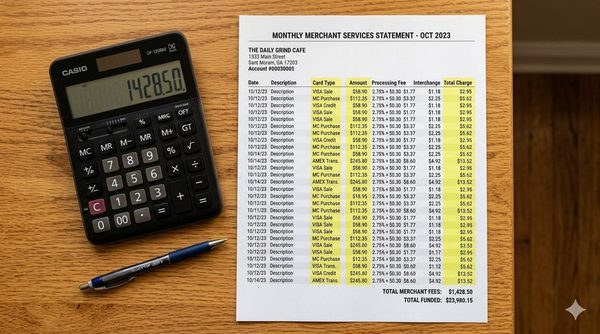
1. Get the qualification report, not the blended rate. Ask the acquirer for interchange qualification at the transaction-category level for a full recent month. A blended effective rate is an average of good and bad outcomes and is structurally incapable of showing you a downgrade problem.
2. Compare category by category against last October. Not effective rate against effective rate — that comparison is contaminated by mix. You want the same interchange category in both periods.
3. Quantify the downgrades. Every transaction that failed to qualify for its intended category has a reason code behind it. Group them. In parking the recurring causes are a small set: authorization-to-settlement amount mismatch in entry/exit and LPR flows, late settlement past the qualification window, chip fallback to magstripe on aging readers, and missing or malformed enhanced data on commercial cards.
4. Re-verify MCC on every merchant account. Confirm 7523 on the statement itself for each location. Mis-coding is most common where parking is billed under a parent hotel, hospital, university, or municipal merchant account.
5. Check small-ticket capture. Bucket settled transactions by amount and confirm that volume at or under the $15.00 threshold is actually receiving small-ticket treatment rather than standard card-present rates.
6. Recalculate the surcharge or cash-discount question. With the revised caps and notice requirements, the arithmetic differs from prior years. Check network rules, then state law, then any municipal or landlord agreement — in that order, because the most restrictive one governs.
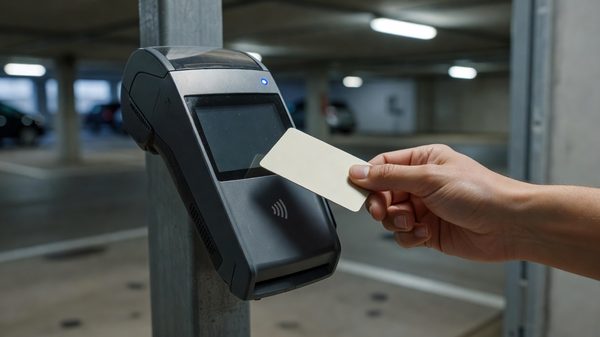
7. Confirm your terminal fleet still qualifies. Kernel versions, contactless configuration, and PTS device status all bear on whether transactions clear card-present. A device approaching end of support is a downgrade problem before it is a security problem.
8. Put the result into the budget as a range. One number implies a precision the schedule does not support. Model the qualifying-clean case and the current-downgrade-rate case, and let the gap between them justify the remediation work.
The Point of the Exercise
Processing cost gets treated as a fixed utility in most parking budgets — a percentage that is what it is. It is not. It is the product of a published schedule, your merchant category, your terminal configuration, your authorization and settlement behavior, and your card mix. Four of those five are things an operator controls.
The October schedule is the annual reminder that the number changed whether or not anyone looked. Reading it is the cheapest cost-control work available to a parking operation, and it is available every fall.