New York General Business Law § 396-ii took effect on 21 March 2026, prohibiting most food stores and retail establishments from refusing cash payment and from charging a higher price for cash than for a cashless transaction. Operators of cashless parking facilities have generally treated themselves as outside it.
That reading is defensible but not settled, and two separate developments complicate it enough that no New York operator should consider the question closed.
The exemption is not cleanly stated
Reporting and legal commentary on § 396-ii diverge on parking. Some analyses describe the law as making exceptions for vending machines, parking facilities, live sporting events, and rentals of consumer goods. Others note pointedly that exemptions common in other states — including for vending machines, parking facilities, car rentals, and live sporting events — are absent.
That is not a difference of opinion about policy. It is a difference about what the enacted text covers, and it usually signals that the operative question is definitional: whether a parking facility is a “retail establishment” within the meaning of the statute, rather than whether parking is named in an exemption list.
For an operator, the practical consequence is that any compliance position resting on “parking is exempt” should be traced back to the statutory text and confirmed with counsel licensed in New York, not adopted from industry summary. The difference between an express exemption and an inferred one matters enormously the first time it is tested.
New York City narrowed it further
The city has its own cashless ban, predating the state law, and in May 2026 the NYC Department of Consumer and Worker Protection issued guidance that matters directly here.
The department clarified that when a business offers goods or services at a physical location and requires or facilitates app payment as part of the customer’s in-person transaction, the transaction is not automatically exempt from the city’s ban. The example given was a parking garage requiring app payment from customers at the garage.
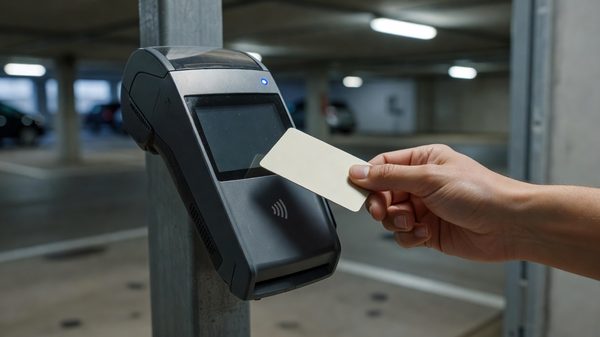
That guidance targets a specific and widespread parking arrangement. A garage with no attendant, no cash-capable kiosk, and signage directing drivers to download an app and pay by phone is precisely the described scenario. The reasoning is that the transaction is an in-person one at a physical location; routing it through an app does not convert it into a remote transaction outside the ordinance’s reach.
Operators who structured around the idea that app payment equals e-commerce equals exempt should revisit that assumption for New York City sites.
The distinction that actually matters
Across cashless-ban regimes generally, the analytically useful line is not cash versus card. It is whether the customer is physically present at the point of sale.
A genuinely remote transaction — a parking session pre-booked from home, a monthly permit purchased online, a reservation made through an aggregator — is straightforwardly an online transaction and outside the concern of these laws. A driver standing at the entrance of a garage being told the only way to pay is to download an application is physically present, and the city’s guidance says that presence is what controls.
Between those poles sit arrangements that need individual analysis: a driver who enters a facility and pays through an app while still on the property, a reservation made minutes before arrival, a pay-on-exit flow handled by phone. These are the cases where “we accept app payment” does not settle the question.
Practical steps for New York operators
Confirm the statutory position in writing. Ask counsel for a written view on whether your facility type falls within § 396-ii, and keep it. If enforcement arrives, a documented good-faith analysis is worth considerably more than a recollection of industry consensus.
Separate city sites from the rest of the state. The NYC guidance applies to NYC facilities. A single statewide compliance position will be either over-broad or under-protective.
Inventory your payment channels by facility. For each site, record whether cash is accepted, whether an attendant is present, whether a cash-capable kiosk exists, and whether the customer is physically present at the point of payment. That inventory is the input to any compliance analysis and most operators do not have it.
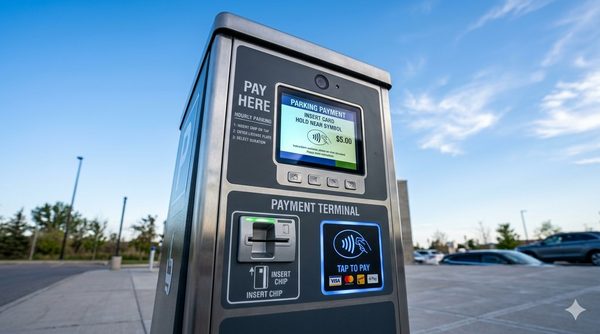
Price out the cash option before you need it. If a cash-acceptance requirement did apply, the compliance routes are an attended booth, a cash-accepting kiosk, or a prepaid card dispenser. Each has a capital cost, a cash-handling cost, and a security consideration. Knowing the number in advance turns a compliance event into a decision rather than a scramble.
Watch the surcharge half. The law also prohibits charging more for cash than for cashless. Operators running differential pricing between payment channels — a convenience fee on one, a discount on another — should confirm which direction their pricing runs.
The broader trajectory
Cashless bans have spread steadily across states and municipalities, and the equity argument behind them — that unbanked and underbanked residents are excluded from cashless commerce — is not going away. Parking has historically been carved out because unattended facilities make cash handling genuinely burdensome, but the NYC guidance shows that carve-outs get read narrowly when the underlying conduct looks like the thing the law was written to address.
Operators planning multi-year facility investments in cashless markets should treat a future cash-acceptance obligation as a live possibility rather than a remote one, and should at minimum avoid designs that would be expensive to retrofit.