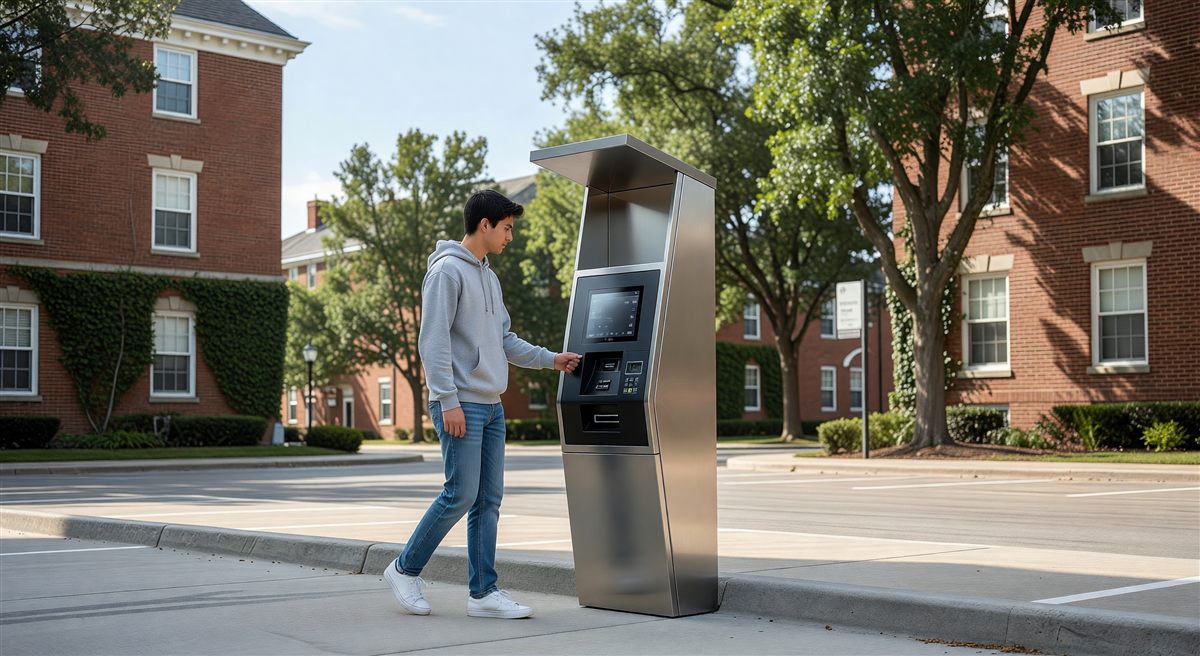
University and college campuses are among the most operationally complex parking environments in North America. A single institution may manage surface lots, multi-story structures, metered visitor spaces, gated faculty zones, and event overflow areas — often simultaneously, and often with conflicting demand peaks.
The payment layer that sits underneath all of this must handle a wider range of transactions than almost any other parking segment: short-term visitor payments, annual permit renewals, event pricing, citation payments, lost ticket fees, and validation programs for campus visitors. Getting this right requires a payment system designed with campus-specific workflows in mind, not a generic commercial solution bolted onto an academic environment.
This guide covers what procurement teams at colleges and universities need to evaluate when selecting or upgrading a parking payment platform.
Why Campus Parking Is Different
Before comparing vendors, it is worth cataloguing the ways university parking diverges from a commercial garage or municipal lot.
Multi-population payment behavior. A campus payment system must serve students paying by mobile app or card, faculty renewing annual permits online, visiting parents who have never used a pay station before, and event attendees who arrive in large waves and need rapid throughput. Each group has different expectations and different acceptable friction levels.
Integration with student account systems. Many institutions want students to be able to charge parking fees directly to their bursar account or declining-balance campus card. This requires a payment system that can authenticate against the institution’s identity provider (often Shibboleth or similar SSO), query student account balances, and post charges to the student information system (SIS) — usually Banner, Workday, or PeopleSoft.
Permit-centric revenue model. Unlike a commercial garage where transient revenue dominates, most campus parking operations derive 60–80% of revenue from permit sales. The payment platform must support permit fulfillment workflows: online purchase, waitlist management, vehicle registration, permit type enforcement, and prorated refunds.
Citation revenue collection. Campus enforcement generates citation revenue that must be collected, tracked, and reconciled separately from permit and transient income. Some institutions handle this in the same platform; others use a dedicated adjudication system that interfaces with the payment layer.
Institutional procurement requirements. Public universities often operate under state procurement rules that require competitive bidding, approved vendor lists, accessibility compliance documentation (Section 508 / ADA), and data residency considerations that private operators rarely face.
Core Payment Capabilities to Evaluate
Transient and Visitor Payment at Pay Stations
Even at permit-heavy campuses, visitor traffic creates consistent demand for pay-at-station capability. Evaluate:
- EMV chip and contactless acceptance. Cards must be chip-read, not swipe-only. Contactless (tap-to-pay) significantly speeds throughput during high-volume periods like move-in weekend or commencement.
- Mobile wallet support. Apple Pay, Google Pay, and Samsung Pay are table-stakes for student-facing payment hardware. Campuses with younger demographics see mobile wallet usage rates well above the national average.
- QR code scan-to-pay. Many campuses are replacing or supplementing hardware pay stations with QR codes posted at stall signage, allowing payment entirely on the user’s phone. This reduces hardware costs and simplifies installation in surface lots.
- Cash handling. Cash acceptance is declining, but some institutions — particularly those serving lower-income student populations or community members — maintain it as an equity consideration. If your campus retains cash, confirm the station’s bill validator reliability, canister capacity, and armored car integration.
Campus Card and Stored Value Integration
The ability to accept a campus-issued card (often called a “OneCard” or similar) is a differentiator for university parking platforms. This typically requires:
- Integration with the campus card system provider (Transact, CBORD, Atrium, or institution-built)
- Real-time balance inquiry at the point of payment
- Posted transaction data returned to the card system ledger
- Support for both online (API-connected) and offline modes if network connectivity is intermittent at remote lots
Not all commercial parking payment vendors support campus card integration natively. Some require a third-party middleware layer that adds cost and a point of failure. Ask vendors for a reference list of campus card integrations they have live in production, and confirm which card system versions are supported.
Student Account Charging (Bursar)
Direct-to-bursar charging is a step beyond campus card integration. Rather than drawing down a stored value balance, the charge posts to the student’s account receivable — visible on their semester billing statement alongside tuition and housing.
This requires API integration with the SIS. If your institution runs Banner, verify that the vendor has a certified Banner integration or can provide documentation of a working implementation at a comparable institution. Workday Higher Education and PeopleSoft integrations exist but are less common in parking-specific platforms.
Bursar charging is particularly useful for annual permit renewals and citation payments, where amounts are larger and students may prefer to spread the cost across a billing cycle.
Permit Management System Requirements
A permit management system (PMS) that is integrated with — or built into — the payment platform eliminates the manual reconciliation that plagues campuses running separate permit and payment tools.
Key permit workflow capabilities:
- Online self-service portal. Students and staff should be able to purchase, transfer, and cancel permits without contacting the parking office. The portal must be mobile-responsive and accessible under WCAG 2.1 AA standards.
- Waitlist management. Popular permit zones (faculty lots, covered structures) often have demand exceeding supply. The system should manage waitlists, notify users when a spot opens, and give a time-limited purchase window.
- Vehicle registration and multi-vehicle permits. Students and faculty often register multiple vehicles and want to split a single permit across them. The system should enforce one-vehicle-at-a-time rules through LPR integration or hangtag logic.
- Proration on refunds. When a permit holder leaves mid-semester, institutions typically refund a prorated balance. The payment platform must support partial refunds with accurate proration logic rather than requiring manual calculation by staff.
- Carryover and auto-renewal. Reducing administrative burden at the start of each academic year is a common request. Auto-renewal with card-on-file capability requires PCI-compliant tokenization; confirm the vendor’s token storage architecture before committing.
Event and Peak Demand Handling
Campus parking peaks are steeper and more predictable than most commercial environments. Graduation, football games, orientation, and open house days can drive demand 3–5x above normal within a two-hour window.
Payment systems must be evaluated under peak conditions, not just steady-state:
| Scenario | Typical Demand Spike | Key System Requirement |
|---|---|---|
| Commencement ceremony | 5× normal | High-throughput lane processing, offline mode |
| Football game day | 4× normal | Pre-pay / advance purchase, LPR validation |
| Orientation / move-in | 3× normal | Extended hours, mobile-first payment |
| Campus open house | 2× normal | Visitor rate pricing, validation codes for admissions |
Pre-pay and advance purchase. For ticketed events, the ability to sell parking passes in advance — linked to the event ticketing system or sold independently — dramatically reduces lane congestion. Evaluate whether the parking payment platform can generate and validate pre-purchased QR codes or confirmation numbers without requiring a separate event parking management tool.
Offline mode reliability. Campus lots often span large geographic areas with inconsistent WiFi coverage. Pay stations and enforcement devices must operate reliably in offline mode, queuing transactions locally and syncing when connectivity is restored. Confirm the maximum offline transaction storage capacity and the sync failure handling protocol.
Integrations Unique to Higher Education
Beyond the standard integrations (LPR, PARCS gates, accounting), universities typically require connections that commercial operators never need:
- Identity provider (IdP) / SSO. Shibboleth, Microsoft Entra ID (Azure AD), and CAS are common. Students and faculty should log in to the parking portal using their campus credentials, not a separate parking-system username.
- Student information system (SIS). For bursar posting and enrollment status verification (e.g., blocking permit purchase for students with holds).
- HR system. Faculty and staff permit eligibility often ties to employment status. HR system integration allows automatic suspension of permits when someone leaves the institution.
- Event management systems. Some campuses integrate parking pre-pay with Eventbrite, AudienceView, or proprietary ticketing platforms to bundle parking at time of event ticket purchase.
Compliance and Policy Considerations
ADA and Accessibility
Federal ADA requirements govern accessible parking space ratios, signage, and path-of-travel standards. On the payment technology side, pay stations must meet accessibility requirements: audio guidance, reachable control height, tactile keypads, and adequate approach clearance. Confirm that vendor hardware has been tested against ADA Accessibility Guidelines (ADAAG) and request documentation.
Section 508 (Public Institutions)
Public universities receiving federal funding must ensure that their electronic and information technology — including online parking portals and mobile apps — meets Section 508 accessibility standards. Ask vendors for their VPAT (Voluntary Product Accessibility Template) documentation for both their web portal and mobile application.
Data Residency and FERPA
Student payment records that intersect with enrollment data may be subject to FERPA protections. Confirm where vendor data is stored and processed, what subprocessors have access to student-identifiable data, and whether a FERPA-compliant data processing agreement is available.
PCI DSS
Campus parking systems are not exempt from PCI DSS. Because universities often have broad cardholder data environment (CDE) scope — multiple payment touchpoints across a large campus — reducing scope through point-to-point encryption (P2PE) and tokenization is especially valuable. A validated P2PE solution removes the physical pay station hardware from CDE scope entirely, significantly simplifying the institution’s annual SAQ or QSA assessment.
Total Cost of Ownership: Beyond the RFP Price
University procurement teams often compare vendors on initial hardware and software license costs, but the total cost of ownership picture is more complex.
| Cost Category | What to Ask |
|---|---|
| Hardware purchase vs. lease | Is hardware included in the SaaS fee or purchased separately? What is the refresh cycle? |
| Integration development | Are SIS and campus card integrations included or billed hourly? Who owns the integration code? |
| Training and onboarding | How many staff training sessions are included? What is the cost for turnover retraining? |
| Payment processing fees | What interchange pass-through rate applies to student debit cards? Are campus card transactions assessed a fee? |
| Support SLA | What is the guaranteed response time for a down pay station during a peak event? |
| Annual price escalation | Is the SaaS fee fixed for the contract term or subject to annual increases? |
What to Ask Vendors During Demos
When evaluating campus parking payment systems, move beyond the standard demo script and push into university-specific scenarios:
- Show me how a student charges a parking permit renewal directly to their bursar account.
- What happens to transactions in progress if the station loses network connectivity mid-payment?
- Demonstrate how a waitlist opens up and notifies the next eligible student.
- How does the system handle a citation payment dispute that results in a partial fee reduction?
- Show me the report I would use to reconcile daily transient revenue against gateway settlement — broken down by lot.
- What is your current list of live campus card integrations, and which version of [our card system] is supported?
Vendors who can walk through these workflows fluently — without escalating to an engineer — have built a product with genuine campus experience behind it. Vendors who struggle are likely adapting a commercial product and will require expensive customization.
Summary
University and campus parking payment systems are not a commodity purchase. The combination of permit-centric revenue, student account integration, bursar charging, event throughput demands, and institutional compliance requirements creates a procurement context that rewards buyers who ask detailed, scenario-based questions.
The institutions that get the most out of their parking payment investment treat it as a campus service platform rather than a fee collection tool — one that reduces friction for students and staff, integrates cleanly with existing campus systems, and gives finance teams clean, reconcilable data at month-end.
Start with a clear inventory of your integration requirements before issuing an RFP. Vendors who cannot meet your SIS, campus card, and SSO requirements on day one will create ongoing operational debt that outweighs any initial cost savings.