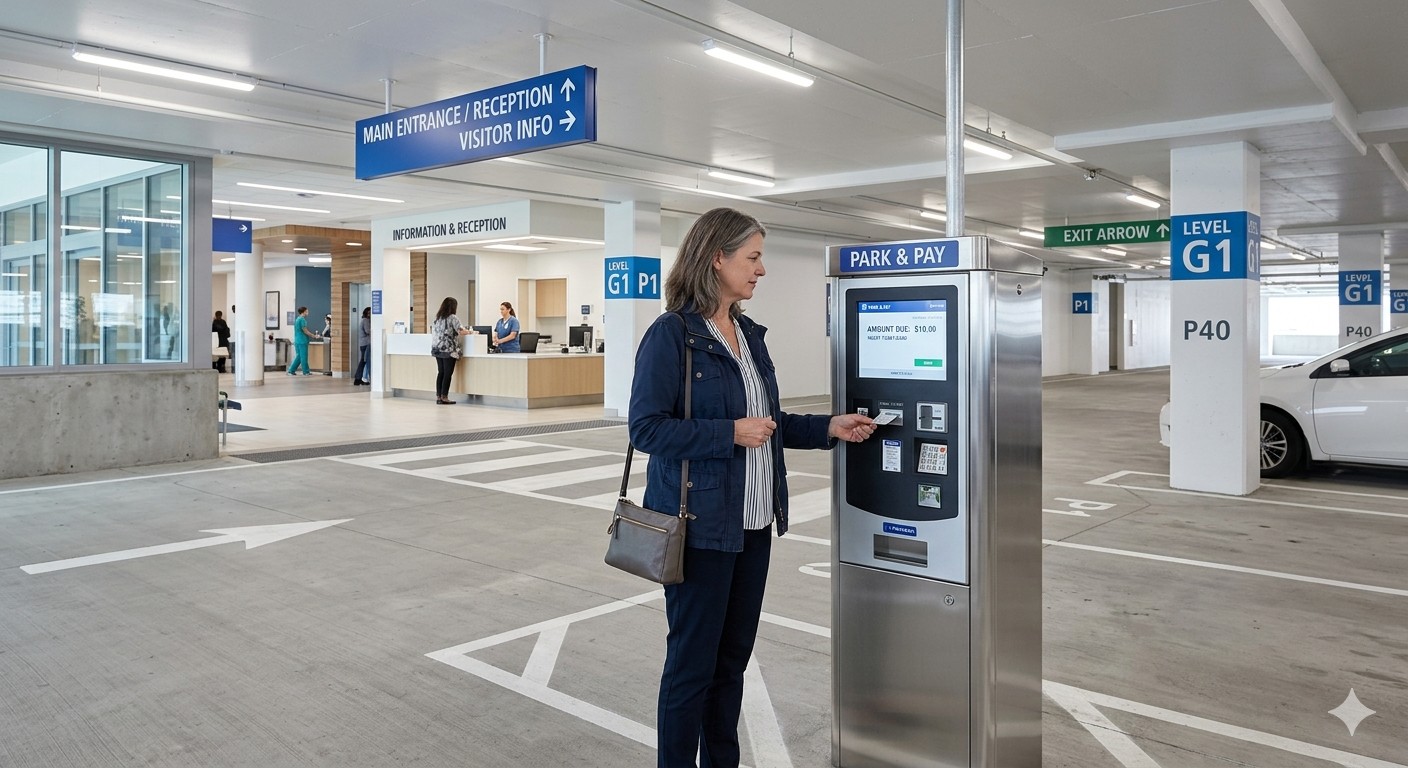
Hospital parking occupies a uniquely sensitive position in the payment world. The people paying for it are often stressed, in pain, or worried about a loved one. They may be visiting daily for weeks during a family member’s extended stay. They might be elderly, mobility-impaired, or navigating a complex medical campus for the first time. And at the end of it all, they receive a parking charge on top of medical bills that are already overwhelming.
None of this means hospital parking should be free. Facilities cost money to build, maintain, and secure. But it does mean the payment experience must be designed with more empathy and flexibility than a typical commercial garage demands. The hospitals that get this right see higher patient satisfaction scores, fewer complaints to administration, and smoother daily operations. Those that get it wrong generate negative press, social media backlash, and in some cases legislative intervention.
This guide examines how hospital parking payment systems can balance revenue needs with patient experience through thoughtful validation programs, discount structures, and accessible payment design.
The Hospital Parking Payment Challenge
Hospital parking differs from commercial parking in several important ways that directly affect payment system design.
Diverse User Populations
A hospital parking facility serves at least five distinct user groups, each with different payment needs.
| User Group | Visit Pattern | Payment Sensitivity | Special Needs |
|---|---|---|---|
| Patients (outpatient) | Single visits, 1-4 hours | High, added to medical costs | Accessibility, wayfinding |
| Patients (recurring) | Daily/weekly for weeks | Very high, cumulative cost | Discount caps, simplified re-entry |
| Visitors | Variable, often multi-hour | Moderate to high | Emotional stress, unfamiliarity |
| Staff/employees | Daily, full shift | Moderate (often subsidized) | Dedicated areas, monthly permits |
| Vendors/contractors | Irregular | Low (business expense) | Validation by department |
A payment system that treats all of these users identically will serve none of them well.
Accessibility Requirements
Hospitals serve populations with higher rates of mobility impairment, visual impairment, and cognitive challenges than the general public. The Americans with Disabilities Act (ADA) and equivalent regulations in other jurisdictions set minimums for accessible design, but best practice goes well beyond minimum compliance.
Pay stations must be reachable from a wheelchair, operable with limited hand dexterity, readable by people with low vision, and intuitive enough for people who are distracted or disoriented. Screen height, button size, font size, contrast ratios, and audio guidance all matter.
Emotional Context
A parent rushing to the emergency department with a sick child should not have to figure out a payment kiosk. A spouse visiting daily during a two-week ICU stay should not face a $25-per-day charge without any discount mechanism. The payment system must accommodate the emotional reality of hospital visits, which means automation, clarity, and compassion built into the system design.
Validation Program Design
Validation is the mechanism by which hospitals reduce or eliminate parking charges for certain users under certain conditions. A well-designed validation program balances patient goodwill against revenue sustainability.
Types of Hospital Parking Validation
Department-based validation. Specific departments (oncology, dialysis, physical therapy) validate parking for their patients. This is common for patients with recurring visits who would otherwise accumulate significant parking costs.
Duration-based validation. The first two hours are free for all visitors, with charges applying only after that. This covers most outpatient appointments without requiring any validation action.
Emergency department validation. ED patients and their accompanying family members receive automatic validation. This eliminates the absurdity of charging someone who arrived by personal vehicle for an emergency.
Financial hardship validation. Patients who qualify for financial assistance with medical bills receive corresponding parking relief. This requires coordination between the parking system and the hospital’s financial counseling department.
Event/class validation. Childbirth classes, support groups, and community health events may warrant validated parking to encourage attendance.
Validation Delivery Methods
How validation is delivered affects both the patient experience and the system’s vulnerability to fraud.
| Method | Patient Experience | Fraud Risk | Implementation Complexity |
|---|---|---|---|
| Automatic (by department/appointment) | Best, no action required | Low | High, requires EMR/scheduling integration |
| QR code from clinic staff | Good, quick scan | Moderate | Moderate, staff must issue codes |
| Front desk stamp/code | Adequate | Higher, codes can be shared | Low |
| Online portal (patient enters ticket number) | Good for tech-savvy patients | Low with authentication | Moderate |
| Blanket time-based (first 2 hours free) | Good, universal | N/A | Low, system configuration only |
The gold standard is automatic validation tied to the patient’s appointment. When a patient checks in for their oncology appointment, the parking system recognizes their vehicle (via LPR) or their ticket number (entered at a kiosk) and applies the validation without any staff intervention. This requires integration between the parking system and the hospital’s electronic medical record (EMR) or scheduling system, which is complex but achievable.
Manufacturers including Skidata, Scheidt & Bachmann, Flowbird, Hectronic, and T2 Systems offer validation modules with varying levels of healthcare system integration. Depth of EMR and scheduling system connectivity varies significantly between platforms, so validating specific integration points with each vendor is essential during procurement.
Discount Structures That Work
Beyond validation for specific visits, hospitals need broader discount structures for frequent visitors and long-stay situations.
Daily Maximum Caps
Set a maximum daily charge regardless of how long the vehicle is parked. For a hospital with a $5/hour rate, a $15 daily cap means a family member visiting an inpatient for 10 hours pays $15 instead of $50. This is the single most important discount mechanism for patient satisfaction.
Multi-Day Passes
Offer discounted multi-day parking passes for families of inpatients. A 7-day pass at 40% off the daily rate gives families cost certainty during a stressful period and reduces daily payment transactions.
Recurring Patient Programs
Patients receiving dialysis (typically three times per week), chemotherapy, or physical therapy should be enrolled in a recurring patient program with reduced or eliminated parking charges. The program should be easy to enroll in, ideally at the point of care, and should not require patients to carry special cards or remember codes.
Employee Parking Programs
Staff parking is a separate but related concern. Most hospitals offer subsidized monthly parking permits for employees. The parking system needs to support monthly permit management, payroll deduction integration, and enforcement (preventing permit sharing).
Sample Discount Structure
| User Category | Standard Rate | Discount Applied | Effective Rate |
|---|---|---|---|
| Outpatient, under 2 hours | $5/hour | First 2 hours free | $0 |
| Outpatient, 2-4 hours | $5/hour | First 2 hours free | $5-10 |
| Visitor, full day | $5/hour, $15 cap | Daily maximum cap | $15 |
| Recurring patient (dialysis) | $5/hour | Department validation | $0 |
| Inpatient family, weekly pass | $15/day | 7-day pass at 40% off | $63/week ($9/day) |
| Employee, monthly permit | $15/day | Employer subsidy | $75-150/month |
Payment System Requirements for Hospitals
Based on the above considerations, here are the functional requirements a hospital parking payment system must meet.
Core Requirements
- Multiple validation programs with rule-based automation (department, duration, financial hardship, event).
- Daily maximum caps configurable by user type and facility area.
- Multi-day and recurring patient passes with simple enrollment.
- ADA-compliant pay stations with wheelchair-accessible design, high-contrast displays, large fonts, and audio guidance.
- PMS/EMR integration capability for automatic validation tied to patient appointments.
- Multiple payment methods including credit/debit cards, contactless tap, mobile payment, and ideally still cash (many hospital visitors are elderly and cash-dependent).
- Clear, multilingual user interface on pay stations and mobile platforms.
- Real-time reporting for finance, operations, and administration.
Advanced Requirements
- LPR for frequent visitor recognition to eliminate tickets for recurring patients and staff.
- Integration with hospital wayfinding systems to guide patients from garage to department.
- Emergency override capability for security or administration to open gates during emergencies.
- Charity care integration linking parking discounts to the hospital’s financial assistance program.
For a comprehensive view of what to evaluate when selecting payment hardware, our buyer’s guide to parking payment systems covers the key decision criteria.
Technology That Supports Patient Experience
Contactless and Mobile Payments
Contactless tap payments reduce transaction time and physical contact, both relevant in a healthcare environment where infection control matters. Mobile payment options let visitors pay from their phone without touching shared surfaces.
The shift to EMV and contactless payment technology is particularly valuable in hospital settings where hygiene is a concern and where many visitors are immunocompromised.
License Plate Recognition
LPR eliminates the need for tickets entirely. For recurring patients, staff, and enrolled visitors, the camera reads their plate and the system handles everything automatically. This is especially valuable for patients with mobility limitations who would struggle to reach a ticket dispenser from their vehicle.
Digital Signage and Wayfinding
Payment-related signage in hospital garages should include not just rates and instructions but also wayfinding to key departments. A patient looking for the cancer center should not have to find a separate directory after paying for parking.
Real-Time Availability Displays
Showing available spaces by level and area reduces the time patients spend circling for a spot. This is not strictly a payment function, but it is part of the overall parking experience that the payment system vendor often provides as an integrated feature.
Operational Considerations
Revenue Reconciliation
Hospital parking revenue reconciliation is complicated by the volume of validations and discounts. Each department that validates parking is effectively spending hospital money, and that spend needs to be tracked and allocated correctly. Regular reconciliation prevents both revenue leakage and department budget overruns.
The National Parking Association recommends that hospital parking operators conduct monthly reconciliation of validation volumes by department, comparing actual validation counts against expected volumes based on patient visit data.
Complaint Handling
Parking complaints at hospitals reach administration faster and get more attention than at commercial facilities. A robust exception-handling process, where front desk staff or a parking office can quickly adjust charges, issue refunds, or apply retroactive validation, is essential. The system must support these adjustments with an audit trail.
Compliance and Data Privacy
Hospital parking systems that integrate with EMR or patient scheduling data must comply with HIPAA and equivalent privacy regulations. The parking system should never store or display patient medical information. Integration should be limited to appointment confirmation (patient has a visit today, department is X) without exposing diagnosis, treatment, or other protected health information.
Community Relations
Hospital parking pricing is a community relations issue. Local media regularly cover stories about parking costs at hospitals, and these stories generate strong public reaction. Proactive communication about discount programs, financial hardship accommodations, and the costs of operating parking facilities helps manage the narrative.
Industry publications and operator associations have covered how healthcare facilities communicate parking policies to their communities, and leading hospitals have developed communication toolkits that smaller facilities can adapt.
Case Patterns: What Works
While specific hospital names vary, patterns emerge in successful hospital parking payment implementations.
Pattern 1: Universal time-based free period plus department validation. The first 90 minutes are free for everyone. Beyond that, specific departments validate for their patients. This covers most outpatient visits automatically and only requires active validation for longer appointments.
Pattern 2: Flat daily rate with aggressive cap. Rather than hourly pricing, charge a flat rate per entry with a low daily cap ($8-12). This simplifies the system, eliminates the anxiety of the meter running during a long appointment, and is easy to communicate.
Pattern 3: LPR with pre-registered patients. Recurring patients register their license plate at their first visit. From then on, the system recognizes them, applies the appropriate validation, and they never interact with a pay station again. Initial setup takes three minutes and saves hundreds of transactions over a treatment course.
Common Mistakes
- No discount for recurring patients. Charging full price to a dialysis patient visiting three times per week is indefensible from both a patient experience and a community relations perspective.
- Complex validation processes. If the patient has to visit three different desks to get their parking validated, the system has failed.
- Inaccessible pay stations. Pay stations with small screens mounted too high for wheelchair users are both a compliance risk and an empathy failure.
- No cash option. Eliminating cash payment at a hospital disproportionately affects elderly and low-income visitors. Maintain at least one cash-capable pay station per facility.
- Ignoring the emotional context. Designing hospital parking payment like a commercial garage ignores the fundamental difference in who your customers are and why they are there.
Key Takeaways
- Hospital parking payment must serve diverse user groups with different visit patterns, payment sensitivities, and accessibility needs. One-size-fits-all pricing and payment flows do not work.
- Validation programs are essential, and the best implementations automate validation through integration with scheduling or EMR systems, removing the burden from patients and staff.
- Daily caps, multi-day passes, and recurring patient programs are the most effective discount structures for maintaining patient satisfaction while sustaining revenue.
- Accessibility is non-negotiable. Pay stations must serve wheelchair users, visually impaired visitors, and people under significant stress. Design beyond minimum ADA compliance.
- Technology choices matter. Contactless payments, LPR, and mobile options reduce friction for all visitors and are particularly valuable in healthcare environments where infection control and mobility limitations are daily realities.
- Hospital parking is a community relations issue. Transparent communication about pricing, discount programs, and financial hardship accommodations protects both patient satisfaction and the hospital’s public reputation.
The best hospital parking payment systems are the ones patients never think about. They enter, they park, they focus on what matters, their health or their loved one’s health, and the payment takes care of itself. That is the standard worth building toward.