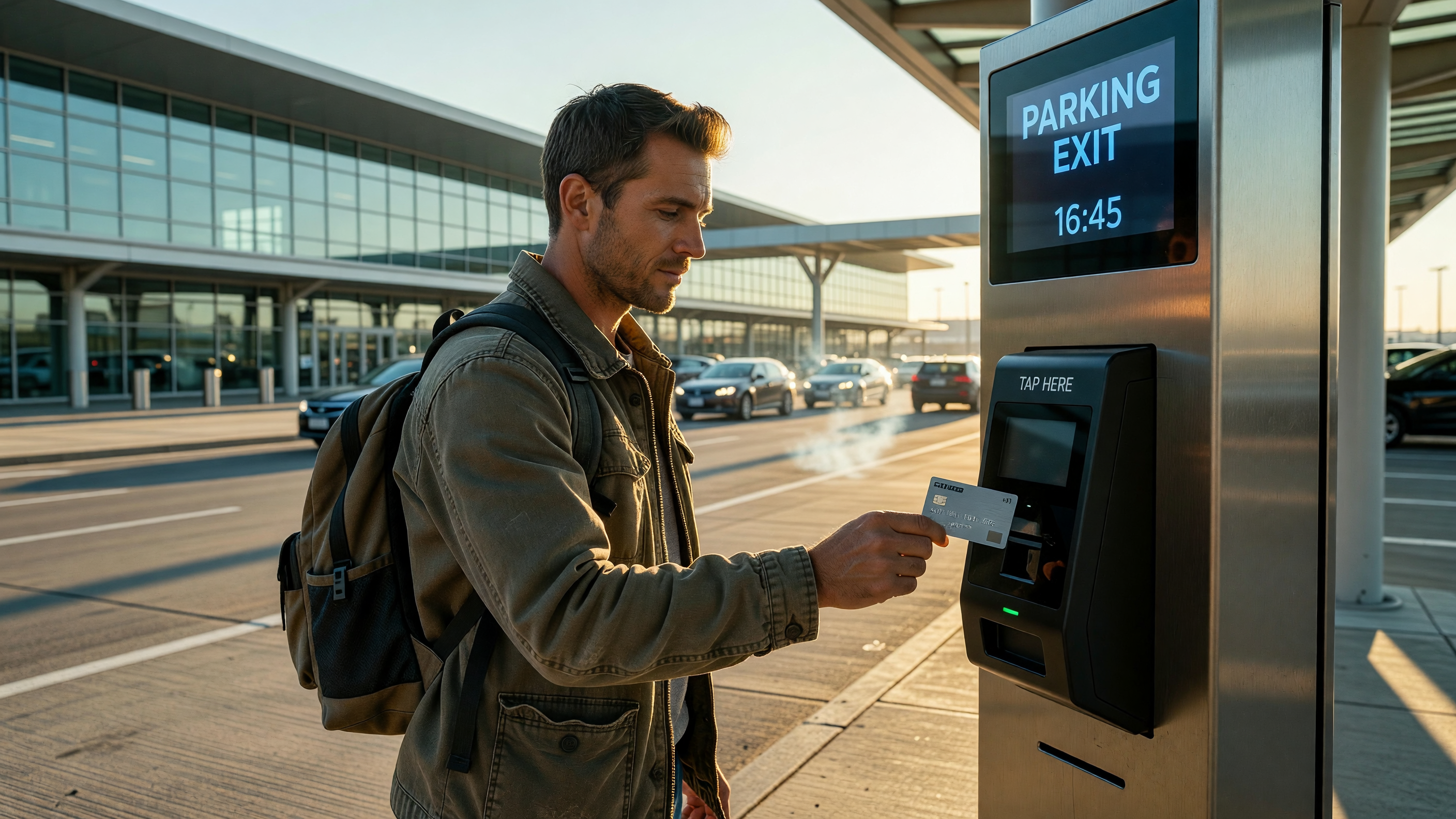
Airport parking is the highest-throughput payment environment in the parking industry. A large hub airport’s economy lots can process thousands of exit transactions in a two-hour departure wave. A missed connection surge can send 400 vehicles to the exit in 30 minutes. Cellular network congestion during holiday weekends degrades payment terminal connectivity exactly when transaction volume is highest.
The payment systems that work adequately during a mid-week February morning need to be architected for summer Saturday afternoons — because summer is when airport parking revenue is highest, when operational failures are most costly, and when the gap between a smooth exit experience and a queue backing into the lot is measured in minutes, not hours.
This guide covers the payment architecture decisions, redundancy requirements, and operational configurations that determine whether an airport parking operation handles summer peak volumes smoothly.
Understanding Airport Peak Payment Demand
Airport parking peak periods are driven by a combination of scheduled departures and seasonal travel patterns. Summer is the most demanding period for most North American airports: peak leisure travel coincides with family vacation season, and the departure waves from busy Saturday mornings produce the highest transaction-per-hour requirements of the year.
The exit surge structure at airports differs from urban event venues. Event parking has one surge — post-event — with predictable timing. Airport parking has multiple overlapping exit surges driven by departure and arrival flight banks, with the heaviest transaction concentration in the 45–90 minutes before and after peak departure windows. A facility that has mapped its historical transaction data by hour and day type will know exactly when its highest per-hour transaction demands occur. Those peaks — not average transaction volume — are what your payment architecture should be designed for.
Lot type matters for payment system requirements. Terminal and hourly lots have short dwell times and high turnover — exit speed per transaction is the critical metric. Economy and long-term lots have lower turnover but periodic large exit surges when flights arrive. Pre-book and reservation-based lots have a different payment profile entirely: most revenue is captured at booking, and exit lane transactions are primarily validation events rather than payment events. Each lot type warrants its own payment architecture assessment.
Pre-Booking and Pre-Payment as Throughput Management
The most effective way to reduce peak exit transaction volume is to eliminate transactions — by capturing payment before the vehicle arrives at the exit lane.
Pre-booking and pre-payment programs shift payment activity from the exit lane to the booking platform, typically days or weeks before the travel date. At exit, the vehicle with a pre-paid booking either uses LPR-based automated exit (no transaction at the lane) or scans a QR code or enters a booking reference for near-instant validation (2–5 seconds per exit, vs. 12–20 seconds for contactless card or 45–60 seconds for cash).
At airports where pre-booking penetration reaches 40–60% of economy lot transactions, the effective exit throughput capacity increases substantially — not because more physical lanes are added, but because the transaction time for the pre-paid segment is dramatically shorter. This reduces queue formation during peak surges without capital investment in lane infrastructure.
Pre-booking requires early integration work. To achieve pre-booking volume at the levels that affect throughput, the booking platform must be surfaced through the channels travelers actually use: airline booking flows, airport apps, Google search for the specific airport parking, and third-party parking aggregators. Airports that rely on direct website pre-booking alone typically see 10–15% pre-booking penetration; those integrated with Google’s parking booking surface and major aggregators see 30–50%+.
LPR-Based Exit: The Highest-Throughput Option
License plate recognition (LPR) at the exit lane is the architecture that produces the fastest per-vehicle exit time — under 3 seconds for a recognized plate with a valid pre-paid or monthly account. LPR-based exit eliminates the need for a ticket, a payment interaction, or any driver action at the gate beyond driving through.
For airport economy and long-term lots with high pre-booking volume or a large subscription/frequent parker segment, LPR-based exit is the throughput maximizer. Implementation requires:
- Entry LPR cameras that accurately capture plates on arrival, logging the plate against the entry time record
- Exit LPR cameras that match the departing plate to the entry record and calculate the charge
- Integration with the pre-booking platform so pre-paid bookings are automatically matched at exit (plate match triggers gate release without additional transaction)
- Fallback payment method for plates that don’t match (damaged plates, rental cars with mismatched records, international plates) — typically a pay-on-foot kiosk nearby or a staffed intercom at the exit lane
LPR accuracy is the critical variable. A lane with 95% plate match accuracy means 5% of vehicles require a fallback interaction — in a high-volume lane that’s a meaningful number of assisted transactions. Require vendors to provide accuracy specifications under the lighting conditions typical of your facility (night, rain, direct sun angles).
Lane Configuration and Physical Redundancy
Peak throughput is only achievable if all lanes are operational. Physical lane redundancy — having more active lanes than you need for average demand, so that a single failure doesn’t create a cascading bottleneck — is the operational insurance policy for airport payment systems.
Active vs. available lanes. At many airports, not all payment lanes are staffed or active during off-peak periods. The surge plan for peak summer periods should define the activation threshold: at what transaction rate or queue length does the operation activate additional lanes? And who is responsible for activating them? A lane that is physically present but unstaffed and unactivated provides no throughput benefit during an unanticipated surge.
Pay-on-foot vs. pay-in-lane architecture. Pay-on-foot (POF) systems — where patrons pay at a kiosk inside the terminal or garage before returning to their vehicles — distribute the payment transaction away from the exit lane entirely. The exit lane interaction is reduced to a ticket/QR scan or LPR match, typically under 5 seconds. For high-volume airports, POF architecture is the most reliable way to decouple payment processing from exit throughput, because the payment transaction can happen anywhere in the terminal at any pace — not sequentially at the gate.
Gate arm failure procedures. Gate arm failure during peak exit surges is the worst-case scenario. An inoperative arm blocks a lane and redirects all traffic to remaining lanes, reducing capacity exactly when demand is highest. Require that gate arms have field-replaceable components stocked on-site, and that staff know the replacement procedure without calling a service technician. A gate arm failure resolved in 8 minutes has minimal impact; one waiting for a technician for 90 minutes affects thousands of transactions.
Cellular Connectivity and Payment Terminal Reliability
Payment terminal connectivity at airport facilities fails in predictable ways during peak periods. Cellular networks serving airport areas experience significant congestion during holiday travel peaks — the same passengers filling your lots are also saturating the cellular spectrum with calls, data, and streaming.
Parking Today has documented that multi-SIM configurations intended to provide redundancy can create their own instability in congested network environments — where switching between carriers in a congested area produces more transaction anomalies than a single stable connection. The practical implication: cellular redundancy needs to be tested under peak-congestion conditions, not just designed theoretically.
Wired Ethernet as primary connectivity. For fixed pay-on-foot kiosks and exit lanes in covered facilities, wired Ethernet to a local server — with cellular as failover rather than primary — is the most reliable configuration during peak periods. The local server queues transactions when connectivity degrades and syncs when restored, preventing transaction loss without requiring uninterrupted WAN connectivity.
Offline authorization modes. PCI DSS allows transaction processing in offline mode with defined floor limits. Most commercial parking payment terminals support an offline mode that approves transactions below a configurable amount without a real-time authorization request. For airport parking where average transaction values are predictable and chargeback rates are managed, offline mode during connectivity degradation is a legitimate operational tool — not a workaround. Verify your terminal’s offline mode configuration and the authorization queue reconciliation process before peak season.
For detailed guidance on structuring payment systems to minimize friction under load, the reducing payment friction guide covers transaction speed optimization applicable across parking environments.
Cashless Transition and International Card Acceptance
Airport parking is among the most favorable environments for cashless transition. Travelers disproportionately carry cards and mobile wallets; cash handling is a security and reconciliation burden for operators; and the transaction speed difference between cash and contactless payment is most visible in the high-throughput lanes that characterize airport exits.
EMV contactless is table stakes. Any airport exit lane that does not accept contactless (tap-to-pay) credit and debit cards is creating unnecessary friction for a large fraction of modern travelers. Apple Pay, Google Pay, and tap card transactions are standard expectations from international travelers in particular, who may not carry US currency and whose chip cards may have difficulty with US magnetic stripe-only equipment.
International card acceptance. Airport facilities serve a higher proportion of international visitors than most other parking environments. International cards — particularly cards issued in Europe and Asia — behave differently than domestic cards at some payment terminals: different chip authentication flows, different PIN vs. signature routing, and some foreign-issued cards requiring online authorization for every transaction. Verify that your payment processor and terminal configuration handles international card variants correctly, and review your terminal’s decline rate by card origin to identify configuration gaps.
DCC (Dynamic Currency Conversion) is a controversial option in international-facing environments. DCC allows international cardholders to pay in their home currency — the airport operator captures a margin on the conversion. The practice is legal and transparent when disclosed, but generates disproportionate cardholder complaints and disputes. For most airport parking operators, the incremental revenue from DCC is not worth the complaint volume and chargeback risk.
Revenue Reconciliation at Airport Scale
Airport parking operations generate high transaction volumes across multiple lots, entry/exit pairs, and payment methods. Reconciliation at scale requires structured processes that identify discrepancies before they become material.
Lane-level vs. session-level reconciliation. Lane-level reconciliation compares reported transactions per lane to actual cashier shift totals and payment processor settlements. Session-level reconciliation traces individual parking sessions from entry record to payment event to exit record, identifying sessions where payment was not captured, where the payment amount doesn’t match the expected calculation, or where exit occurred without a payment event (tailgating, gate arm failure, offline mode approval). Both levels are necessary; neither alone catches all discrepancy types.
Transaction reconciliation across payment channels. A facility with pay-on-foot kiosks, mobile pre-payment, monthly accounts, and intercom-based exit assistance has four payment channels that each settle separately. Cross-channel reconciliation — ensuring that total revenue reported by all channels matches total revenue recorded in the PARCS entry/exit database — is the essential control. For detailed reconciliation frameworks applicable to multi-channel airport payment environments, see parking revenue reconciliation.
Frequently Asked Questions
What payment architecture is best for high-volume airport exit lanes?
LPR-based exit for pre-paid and monthly accounts, combined with pay-on-foot kiosks for walk-up transactions, produces the highest throughput. This separates the payment transaction from the gate interaction — pre-paid vehicles exit in under 3 seconds; walk-up patrons pay at the kiosk before returning to their vehicles and exit without a payment transaction at the gate.
How do I prevent payment system failures during airport peak periods?
Three measures: wired Ethernet as primary connectivity (cellular as failover, not primary), offline transaction authorization mode configured and tested, and gate arm replacement hardware stocked on-site with staff trained on field replacement. Most peak-period failures are connectivity and gate arm issues — both are preventable with pre-season preparation.
Should airport parking lots accept cash?
Operationally, cashless-only or strongly cashless-preferred is the right direction for airport lots. Cash handling creates security risks, slows transaction time, and complicates reconciliation. Most airports have transitioned to accepting cash only at staffed lanes with a cashless-first default. Complete cash elimination requires attention to ADA and accessibility requirements — some patrons may be unable to use card-based or mobile payment.
How does pre-booking affect exit lane throughput?
Directly. Pre-paid vehicles with LPR-based exit complete in under 3 seconds vs. 12–20 seconds for contactless card payment. At 40% pre-booking penetration, a facility’s effective throughput capacity can increase by 20–30% without adding lanes — because the average transaction time across the mixed vehicle stream drops materially.
What should I check before summer peak season for airport payment systems?
Terminal EMV and contactless certification, offline authorization mode configuration, cellular connectivity backup plan, gate arm replacement hardware inventory, pre-booking platform integration with booking aggregators, and international card acceptance settings. Run a full system test on each exit lane under simulated peak conditions before Memorial Day.
How do airports handle parking payment for international travelers?
Accept EMV chip, contactless, Apple Pay, and Google Pay — these are standard across most international card issuers. Verify that your payment terminal handles foreign-issued chip cards correctly (some require PIN routing that US-configured terminals mishandle). Avoid DCC unless you have a specific revenue case for it; the complaint and chargeback cost typically exceeds the conversion margin.